This page relates largely to an area between Boardmills and Killyleagh/Killinchy in the east of County Down. The Jacksons feature heavily in the parishes of Kilmore and Killinchy, whilst the McKees were prominent in Killaney parish.
THIS IS A WORK IN PROGRESS AND THERE MAY BE ERRORS WHICH WILL BE CORRECTED IN TIME
Below is a map of part of the area. Barnamaghery is in the centre but extends further north. Creevybeg is to the North East and Clontaghnaglar on the western side. Ballyalgin is at the eastern side.
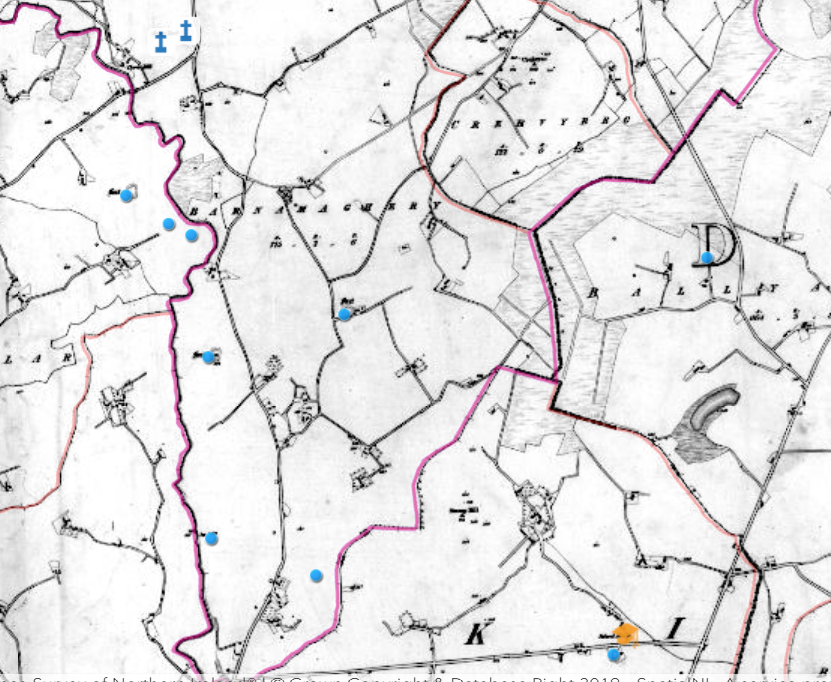
Whilst the maps associated with Griffith’s Valuation usually include red lines denoting townland boundaries and more red lines with numbers and letters which show the holdings of each farmer or tenant, for some reason this section of map does not. Normally there are up to 5 maps showing different periods of time available; again this area has only one, it seems.
This makes tying specific people to specific parcels of land and houses much more difficult. I have used BMD information as well as land information, the two available censuses, wills and newspapers to help unravel information. I am also most grateful to Alan Thompson and his wife Carol and to Lily Cunningham for information.
The detailed census information for Ireland which would most help genealogists has been lost almost entirely due to the explosion at the Four Courts in Dublin during the Irish Civil War. The later 1861 and 1871 census records were destroyed after they had been analysed due to a zealous interpretation of the wording of the legislation. Those from 1881 and 1891 were pulped during WW1, whether to reduce fire risk (ironically), save space or to be recycled at a time of shortage is uncertain.
Nonetheless, there is some useful information available at virtualtreasury.ie website. For instance, we can see that the townland of Barnamaghery in Kilmore, 775 acres in size,had a population of 430 in 1841. Ten years later it had declined to 359. By 1861 the population stood at 330. This comprised 145 males and 185 females. Sadly, they did not analyse age groups.
The number of inhabited houses had declined from 91 in 1841 to 77 in 1851, ie 14 houses were now empty or gone. Actually, they provide another piece of information- that there were 4 uninhabited buildings. This suggests that a number of houses had been destroyed or left to rot. It is possible that this is evidence of some families simply leaving altogether.
646 acres of Barnamaghery lies within Killinchy parish, of course. It was a slightly smaller area but had a similar population of 448 in 1841. Again, there was a considerable decline over ten years, down to 352. By 1861 there were 167 males and 169 females, a total of 336. Houses had declined from 84 to 70, 67 of which were occupied.
Looking at the combined area of Barnamaghery, the population was 878 in 1841 living in 175 houses to 711 in 1851. By 1861 the combined population had declined further to 666 people living in 144 houses. This shows that the period of the potato famine and beyond saw a considerable change in population in the townland. One other thing it highlights is that there are likely to be many people whose names are simply not recorded at all or only appear fleetingly in records.
Aughnadarragh, just north and west of Barnamaghery and in Killinchy parish, held 552 acres and a population of 277 in 1841, falling to 246 in 1851. By 1861 the population was 228. The trend was downward but not to the same extent as Barnamaghery.
Creevybeg (Killinchy) was a smaller townland of 122 acres supporting 50 people in 184, then 42 ten years later (down 16%) and only 27 in 1861. The number of people was now over half what it had been twenty years earlier. There were 6 inhabited houses in 1851 compared to 9 in 1841.
Raffrey was a large townland of 1396 acres. There were 768 people living there in 1831 but 632 ten years later. By 1861 the population had declined further to 489. The number of occupied houses had reduced from 131 to 113 to 95 by 1861 (with 3 more unoccupied).
Killinchy in the Woods is a townland of 988 acres, confusingly inside Killyleagh parish. Its population reduced from 487 to 297 in 1851, a huge decrease. Ten years later there were 291 people, living in 51 houses with three more unoccupied. This compared to 86 houses in 1841 and 63 in 1851.
Clontnaghnaglar’s 932 acres lie within Kilmore parish. In 1841 there were 415 people, reduced to 235 in 1851. By 1861 the population was 245.
Lissara is a small townland of 145 acres in Kilmore parish. Its 1841 population of 67 fell by more than half to 31 within ten years. In 1861 however the number had risen back to 59. The number of houses reduced from 17 to 14 and then to 11, with a further 5 uninhabited.
There are a lot of Jacksons in these townlands today and there were many in the 19th century, too. The website link barrygriffin.com/surname-maps/irish/jackson is invaluable in providing a breakdown of surname distribution.
There were 3913 people surnamed Jackson in 1901, and it was the 227th most common name in Ireland. Over 39% of Jacksons were members of the Church of Ireland, over 26% Presbyterian, 22% Roman Catholic and 5% Methodist.
A distribution map shows that this area of County Down was one of several where there were between 1000 and 10,000 Jacksons per 100,000 total. This does not mean, of course, that there were actually that number of Jacksons since there was a total of 3913 Jacksons on the whole island, it merely shows that the name was clustered heavily in these red areas on the map.
In fact, there were 488 Jacksons in County Down in 1901. Sixteen were in Crossgar DED (including Killinchy in the Woods and Derryboy), 7 in Kilmore DED, 6 in Killyleagh, 7 in Killinchy and 3 in Saintfield DED.
The largest concentration, however, was 67 in Leggygowan. Leggygowan included the townlands of Crewybeg or Creevybeg (7), Raffery (14), Barnamaghery (20), Carsonstown (16) and Lisown (10).
This should illustrate that there are a lot of Jacksons in and around Barnamaghery and that it is challenging to disentangle the different branches. Doing so is not helped by the lack of detailed locations on the Griffith’s Valuation maps.
The 1901 and 1911 census details are available, free to peruse, at census.nationalarchives.ie. This is for the whole of Ireland. From this we can see how many Jackson households there were in each townland. Thus, Creevybeg and Lisown had one household each. In Carsonstown there were 4 households. In Raffery there were 6 households: houses 8, 9, 13, 15, 16, and 76. The number is not a street number as we would understand it but indicates proximity as the enumerator walked or rode from house to house. So, 8 and 9 are very close together, 13, 15 and 16 are likely to be close to each other. This could indicate that these are close relatives on land which in the past was held by one Jackson but was divided later between children or could indicate sons marrying and building a house of their own on their father’s land.
Barnamaghery, of course, had far more Jacksons. They lived at houses 4, 31, 32, 33, 37 and 38. As it happens, it is these two last houses which are the starting point for Helen’s ancestors. They can be pinpointed through several sources- driving with Helen and her mum to the location where she was born, consulting the OS map for 1835 and 1901, and a combination of Google Earth and Streetview.
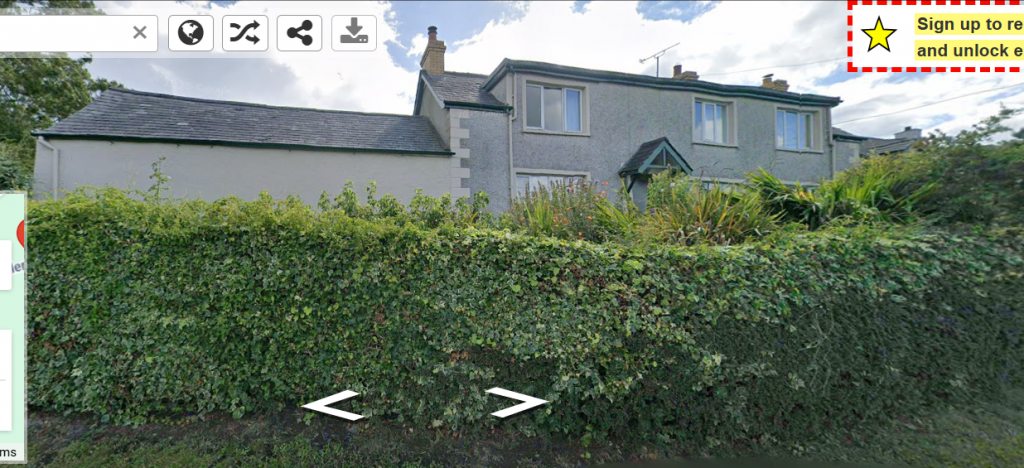
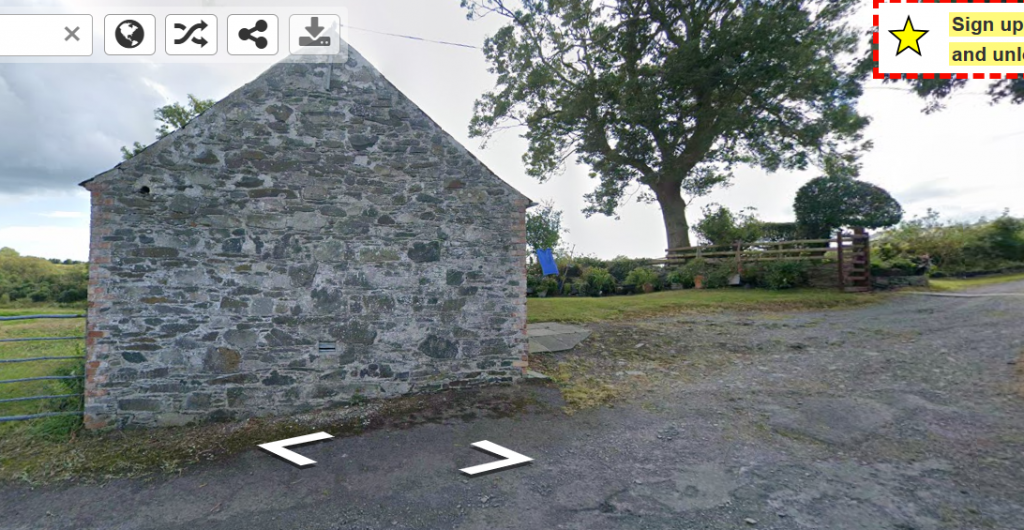
The map extract below is copyright NLS and dates from 1880 -1913. Joan was born in the first house on the left on the southern side of the road. The NLS allows viewers to see the same area over time and the previous map, 1860-1878 does not show it or the adjacent house existing. The road is the Castlerainey Road.
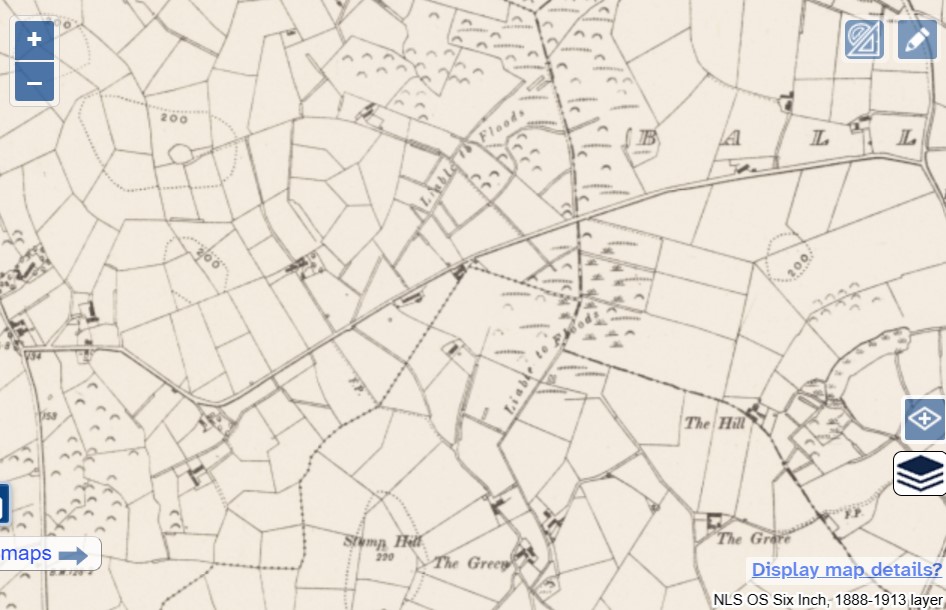
The map extract at the top of this page, from 1835, shows that the house is only just inside Barnamaghery townland, with the hedge at the back acting as the border with Killinchy in the Woods townland. This Barnamaghery is in Kilmore parish, meaning the church records for Kilmore would be the ones most likely to relate to these Jacksons.
Joan’s father was John Jackson McKee and he had been born on 6th June 1899 at Barnamaghery, almost certainly in the same house.

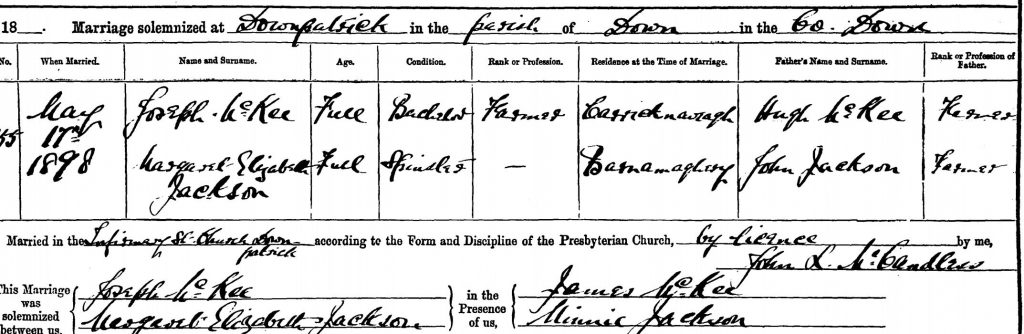
John Jackson McKee was an only child. His parents had married the year before and their marriage certificate is shown below. His middle name, of course, was his mother’s maiden name.
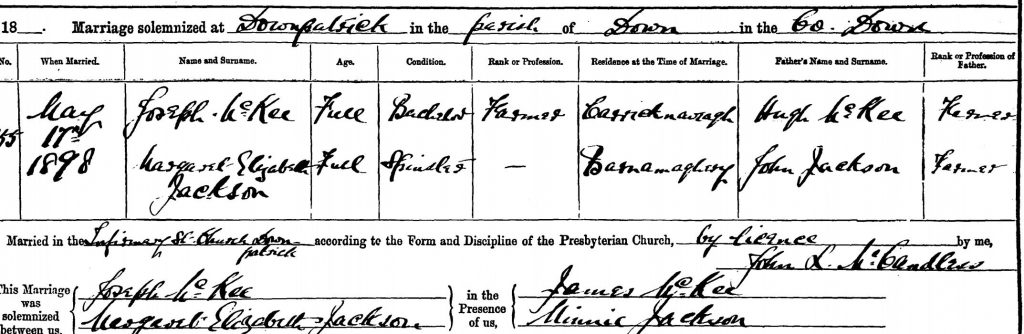
The witnesses to the wedding may have been his father’s brother James and Margaret’s sister Minnie. Minnie is usually a version of Mary Jane. An alternative Minnie exists, related further below, a neighbour of the McKees at Barnamaghery who was also a cousin. The McKees are explored elsewhere.
Unfortunately Irish wedding certificates were not required to record exact ages of those marrying. Some registrars did so but others only recorded whether the parties were of full age.
The 1901 and 1911 censuses give some more information on the family and their home. They are shown at house 38 at Barnamaghery. The first page tells us little new other than that they are living in the home of Margaret’s elderly father, John, who was around 81 years of age.
A useful detail of Irish censuses is the other pages which give information about the house itself and outbuildings.
From this we learn that House 38 had 5 outbuildings. The house walls were of stone, brick or concrete rather than turf or wood. The roof was of slate, tile or iron rather than thatch.There were 5 or 6 rooms in the house and 6 windows faced the front.
One other piece of information gleaned is that the next house was lived in by Eliza Jackson and that house 33 was that of William Jackson. It is likely that these were relatives of John Jackson. House 4 was held by Robert Jackson. Indeed, Joan McKee knew that Eliza’s daughter Minnie Jackson was a cousin of her mother or of herself.
This is the two houses on the Castlerainey Road which are shown on the map above.
John Jackson McKee’s maternal grandfather, John Jackson, died in December 1905 of senile decay which might just mean old age. Young John would have been around 5 at this time. Young John’s mother Maggie registered the death. John was apparently buried at Raffrey. I write “apparently” because I have not been able to locate the grave. I will try at Lissara graveyard and Kilmore as these are older Presbyterian burial grounds and it is possible that there was a family plot at one of these.

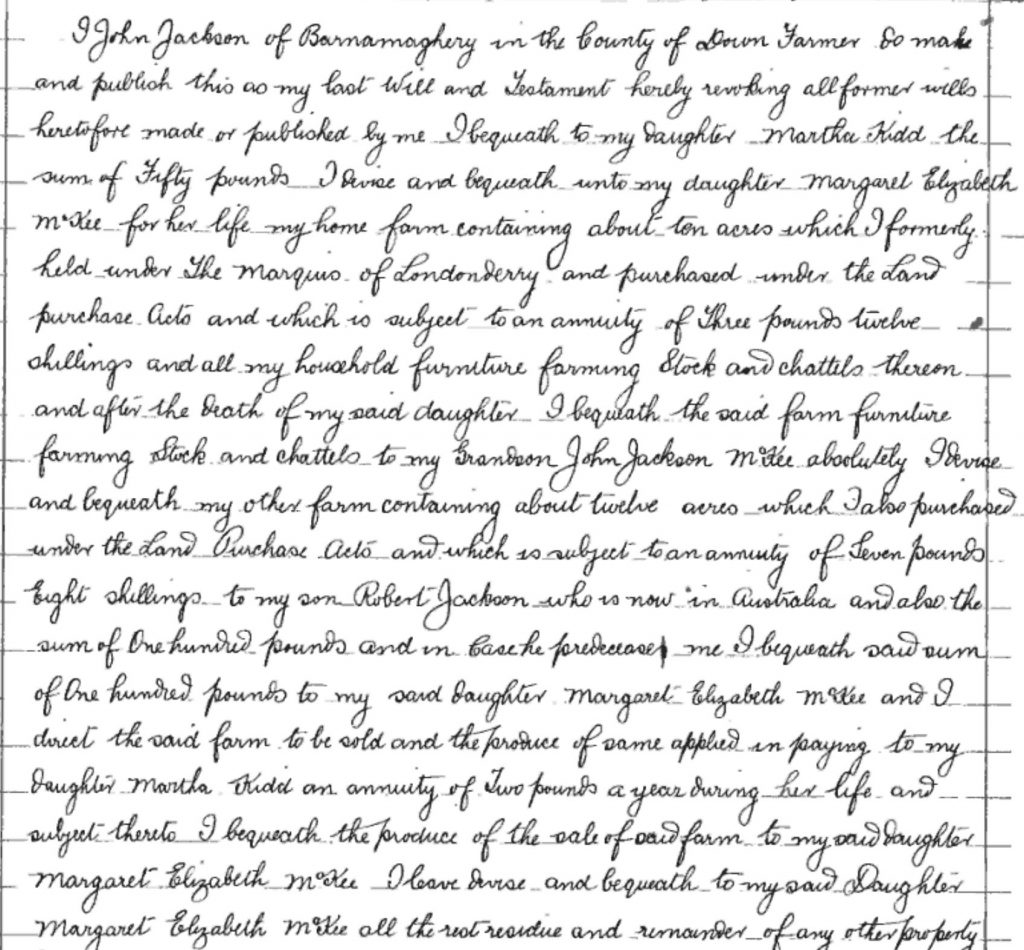
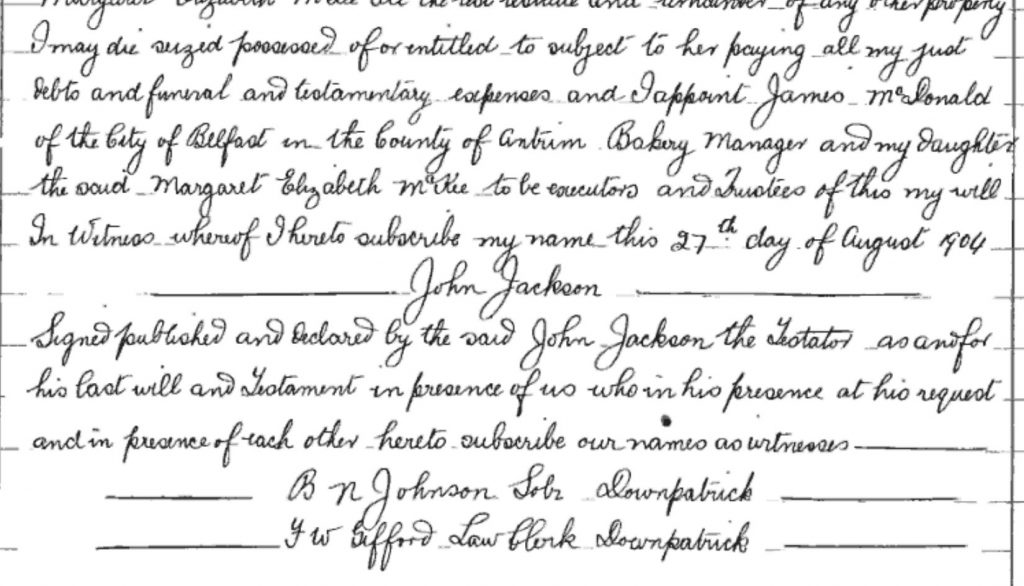
John Jackson left a will, always a useful thing for family historians. It is reproduced below, without apologies for the length, because it is so helpful.
The first point to note is that by referring to Margaret Elizabeth by her married name it means there is no doubt that it is the correct Jackson branch of so many in the Raffrey area.
Secondly, it names two siblings. This is helpful given that Irish records did not record the mother’s name or surname.
The disposal of his estate is helpful in that he pointedly does not refer to son Robert having a wife or children, does tell us that he has emigrated to Australia and goes on to explain that he had bought the house from the Marquis of Londonderry.
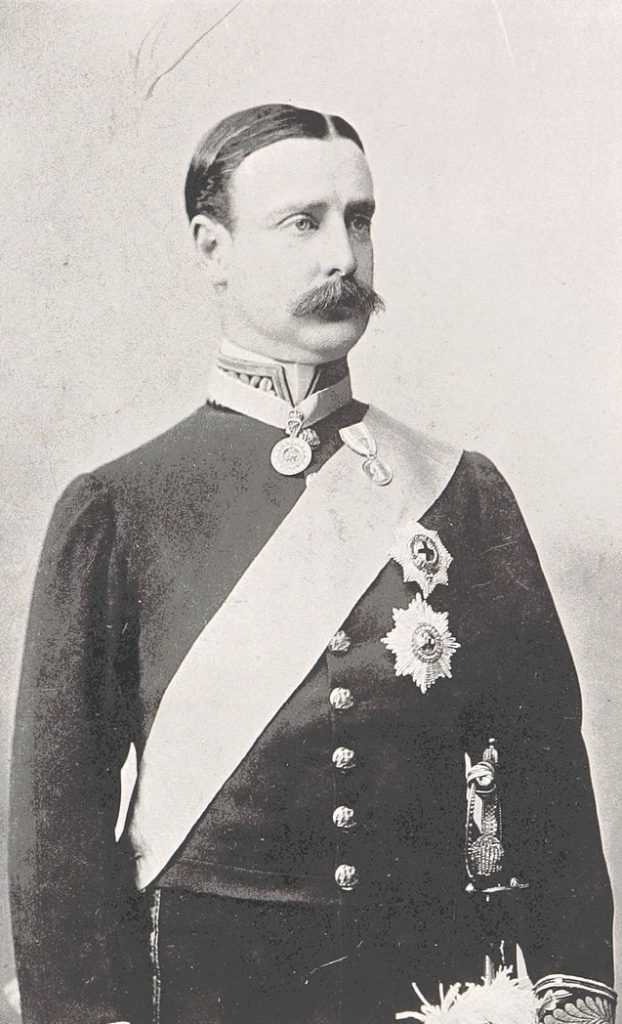
Charles Stewart Vane-Tempest-Stewart, 6th Marquess of Londonderry, KG, GCVO, CB, PC, JP, DL 16 July 1852 – 8 February 1915 image from Wikipedia.
This politician and landowner pops up again with regard to another useful source for genealogists, the Solemn League and Covenant.
Below: the will of John Jackson; many wills are available to view for free at nidirect.gov.uk. Others may be viewed at PRONI (from 1900 onward).
Late 19th century legislation allowed tenants to purchase their holdings at favourable rates, thus giving small farmers the incentive to make improvements for themselves and till the ground as best they could whilst also removing the need to pay rent to a landlord. Of course, they were still liable for rates.
Find My Past has records of these land purchases which the government facilitated.
The image below shows several Jackson land purchases in Barnamaghery:
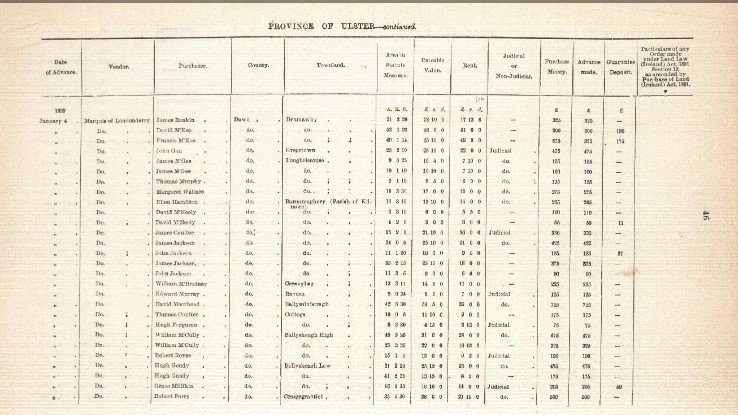
Note that there are two references to a John Jackson, both for 11 acres of land which were purchased from the Marquis of Londonderry. Purchase price of the first was £185 for which he paid a deposit of £37. The second purchase was only for £90.
Above and between the two Johns are two Jameses purchasing a larger area of land.
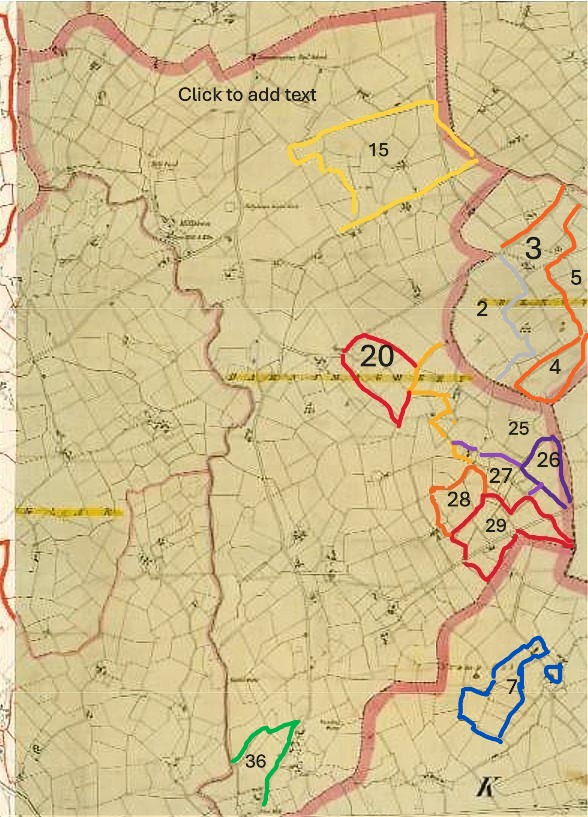
June 2026. This is an amended map from Griffith’s Valuation on askaboutireland.ie; crucially, I have been able to view the actual Griffith’s map at PRONI and see the boundaries of each tenant’s land. As a result I have been able to mark John Jackson’s landholding (area 29) as well as Robert Jackson’s (area 28, adjacent to John’s). Robert Jackson – whether the same or another- held areas 3 and 4 in Creevybeg townland, a little of which is marked on the map. You can see how close the holding of William Jackson in Killinchy in the Woods is.
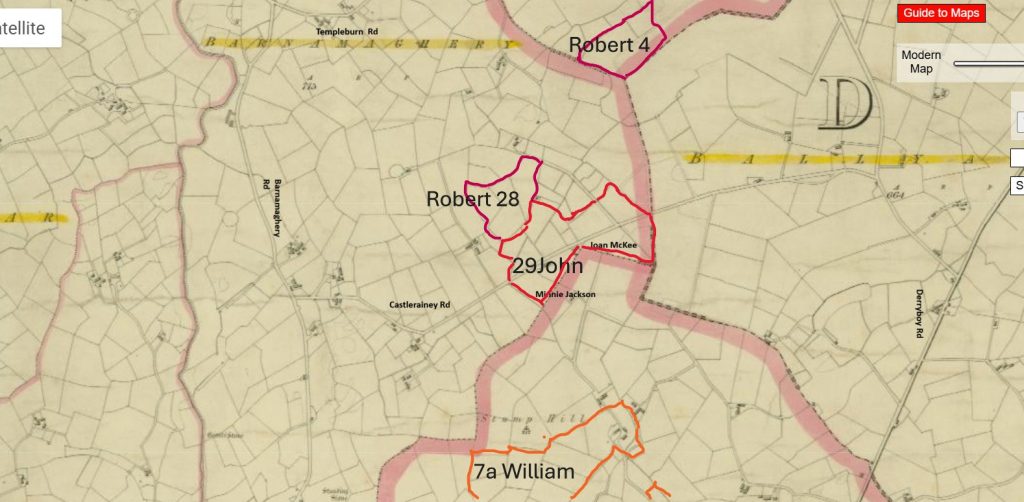
Looking at the 1897-1907 Land Valuation Books we can see that the Kilmore portion of Barnamaghery townland contained 14 houses or parcels of land held by a Jackson, totalling around 141 acres. This includes the two parcels of land held by Joseph Mckee of 11 and 10 acres each.
One was nominally in his wife’s name; the other had been designated by Joseph’s father in law to his son Robert, then in Australia. We still do not know if Robert returned home to sell this farm to his brother in law, sold it from Australia or indeed was still alive. What we can be sure of, however, is that the lands Joseph farmed were the same parcels his father in law farmed in 1864 but with different numbers (essentially 40 was added to most of the plots eg 20 became 60, 29 became 69).
Plot 20 was not held by John Jackson, or any Jackson, in 1864 but by a Stewart Allen. It must have transferred fairly soon to John, however, as the land valuation book for 1865-1875 shows that he held it.
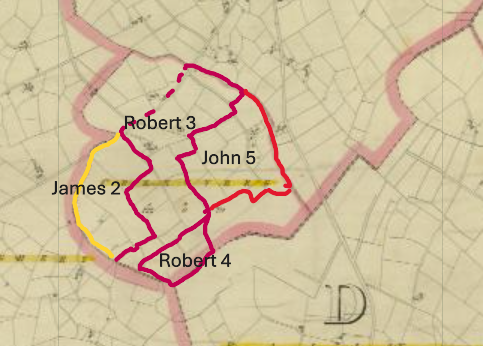
The Creevybeg holdings of three Jacksons. The dashed line is where I have difficulty discerning the boundary but I think it is correct.
July 2026: I have found an indenture or lease dating from 1713, during the reign of Queen Anne (the last Stuart monarch in place in England, Scotland or indeed Great Britain for the last 7 years of her reign).
This indenture is between a landowner in Creevybeg (described as being part of Barnamaghery) and two local men:
“Between Basil Dixwell of Broom, baronet, his wife Dorothy and Edward Pryce and William Jackson of Creveybeg husbandmen … to farm let… all that parcel of land of Barnamaghery commonly known by the name of Criveybeg now in their own possession situate lying and being in the barony of Castlereagh… together with their ? these woods and under woods .. pasture feedings, commons, boggs, profits … to have and to hold … unto … from the first day of all saints past last …term of thirty one years.”
This is not set at their lifetime as it refers to the heirs of all four. Rent was set at £4 yearly to be paid in 4 installments and tithe payment was also to be paid as well as for them to grind corn and all other grindable seeds at mills as specified by Dixwell or his heirs.
Interestingly, it implies that William Jackson and Edward Pryce had held these lands under Dixwell’s predecessor Robert Colvill. Robert Colvill had bought the estate from Hugh Montgomery’s family.
According to Trevor McCavery, Newtown: A History of Newtownards, The White Row Press 1994 Dr Colvill was a wealthy Anglican clergyman who had loaned £1000 in 1652 but after 20 plus years it had not been repaid and eventually most of the estate was sold to Captain Robert Colvill on 12th November 1675. Robert was the heir of Dr Colvill.
Robert Colvill died in 1697, succeeded by his son Hugh who died young in 1701. Thus the estate was in the hands of a child named Robert and with his mother remarrying this younger Robert was persuaded to name his mother’s second husband’s son as heir in 1721.
What seems clear then is that the lands in Creevybeg were farmed by Edward Pryce and William Jackson prior to 1697. Presumably at some point between 1697 and 1713 this Barnamaghery portion had been sold to Dixwell but this is not within the scope of a book focussed on Newtownards.
It seems quite possible that this William Jackson was an ancestor of the Jacksons who farmed at plots 2,3, 4 and 5 in the SW corner of the small townland of Creevybeg in the 1860s. More than that, given that 28 and 29 are so close, these could also have been farmed by William.
John must have had a very tidy mind for he sets out his surviving children by name: Martha Kidd, Margaret Elizabeth McKee and Robert Jackson in Australia. Martha’s family will be focussed on further below.
Photo below was taken by Gerry Hanna and shows John Joseph McKee, his daughter and their eldest grandchild.
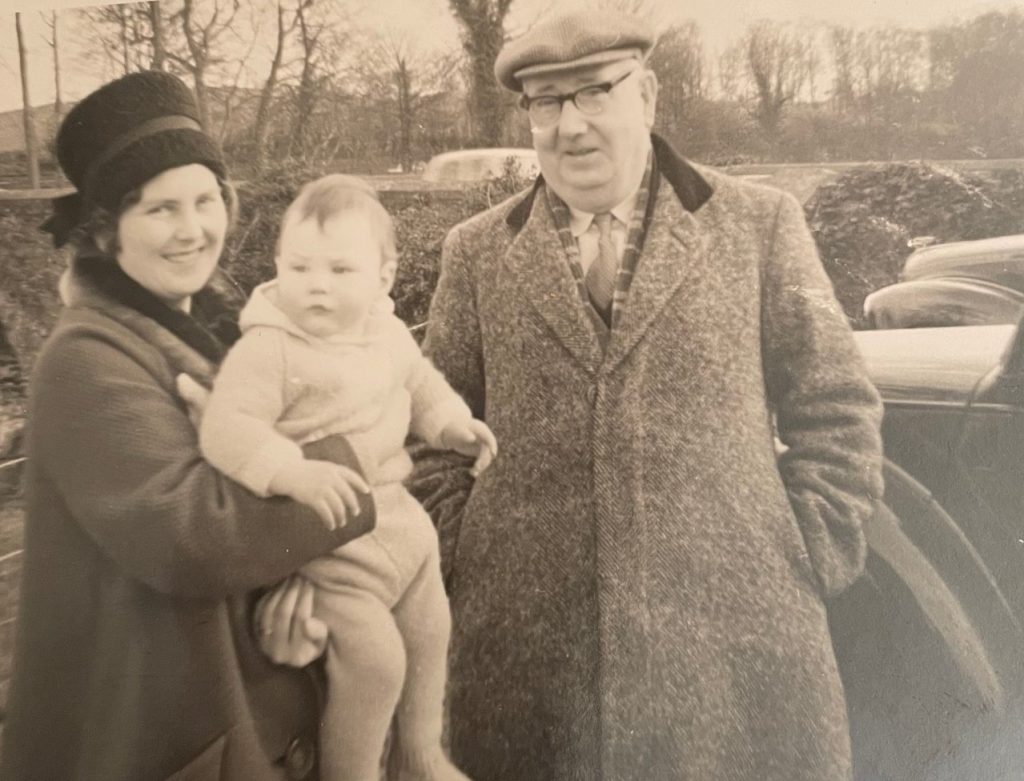
My research has demonstrated that John Jackson had more children than those listed in the will above: Rachel Jackson who was born in 1855, Susannah Jackson (1858-1885) and Alice Jane Jackson.
Susannah certainly died unmarried, I have seen her death registration, which explains why she is not referred to. My working assumption is that Rachel also died, before civil registration was introduced in 1864. However, I note that a witness to the wedding of Martha was a Rachel Jackson in 1885.
Alice Jackson died before 1900 and documents clearly show that Alice bore two children to her husband, farmer John Jackson Thompson. John referred to his grandson John Jackson MacKee so why not refer to these two? Perhaps he felt that they were well enough provided for by the Thompsons.
Rates Valuation Books exist for the period of Griffith’s Valuation of the 1860s through to 1929 and these are a useful source of information and detail.
The extract below from PRONI (available online at their website) shows the changeover in ownership from John Jackson to his son in law Joseph McKee. The first column gives the house number in the valuation book; houses had their numbers changed so this was now number 60 and in theory this should be easy to locate on a land map. The change of name is in green and the last column as well as the inside cover of the book tells us the formal changeover was recognised in 1907 (of course, Joseph had actually held the land for over a year already). The farmland consisted of over 11 acres valued at £9-10 shillings, and the house was valued at 10 shillings.

The same book entry for Number 69. Note the number in black in the first column which shows the original number used for each farm in Barnamaghery before the merging of the Killinchy and Kilmore parts of the townland, achieved by adding 40 to all numbers above 39 as the first 39 entries pertained to the Killinchy, northern, part of the townland.

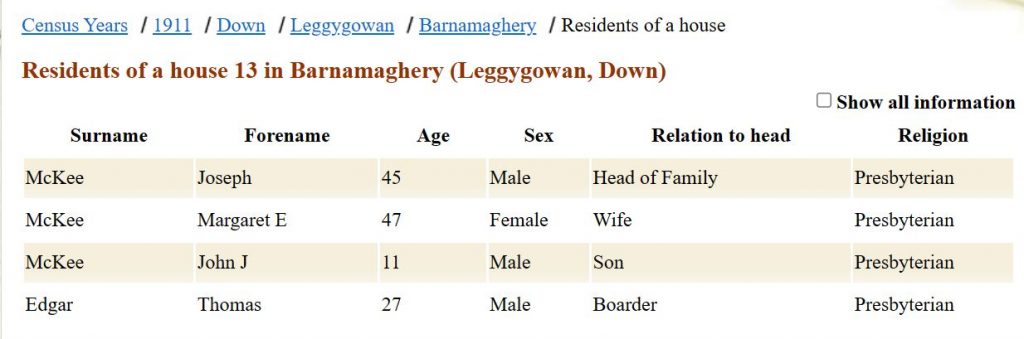
The 1911 census listed the McKees at House 13 Barnamaghery, the house left them by John Jackson. Living with them was the local school teacher. Home-school communication must have been quite straightforward in this family. The extra pages imply that this is the same house as on 1901. The owner was Joseph McKee. House 10 was owned and occupied by Robert Jackson; Houses 11 and 12 were owned by a John Jackson, 16 was occupied by William Jackson but owned by James Jackson. This was a tightly knitted Presbyterian community.
The community felt itself under threat, however. There had been a growing demand for Irish self-government for a generation. The Liberal government of the 1910s had agreed to grant this, not least because it was depending on Irish Party votes in the House of Commons.
Previous efforts in the 1880s had been scuppered by the House of Lords where the Conservative peers were stronger. However 1910 had seen a landmark in British politics where the governing party had had difficulty passing it’s budget. The Prime Minister warned that if the House of Lords blocked the budget he would respond by creating hundreds of new peers of his choice. This threat worked and in effect the House of Lords lost it’s right to block legislation agreed by the lower chamber.
What this meant for Ireland was that opponents of Home Rule were no longer guaranteed that the plan would be scuppered. They were deeply concerned. Those promoting Home Rule said that Westminster would remain sovereign and they would not attempt to weaken the ties further. They said they would act in the interests of all Irish people. Opponents were concerned that this was the thin end of the wedge and that an Irish parliament would push for increasing powers until the link with Britain was tenuous or severed altogether. They were concerned that increasing independence would weaken Ireland’s economy. They were concerned at the prospect of the Irish cultural revival becoming something forced upon them. For instance, there were those who wanted teachers to be forced to go to those parts of Ireland where Gaelic was spoken in their holidays. If that was forced upon them it was to ensure that Gaelic was taught to children in school. They were concerned that the Irish Party was too close to the Roman Catholic church and that it could start to influence the direction of the country.
The result was that there were two groundswells in Ireland around 1911. One was for Home Rule where a rising, predominantly Catholic, middle class would lead Ireland on a path possibly away from it’s link with Britain and possibly towards a less secular society. It is likely that the majority of Irishmen supported this.
The other groundswell was totally opposed to this. These people signed a Solemn League and Covenant, inspired by those of 1639 in Scotland. This stated that they were completely opposed to Home Rule. This petition was signed by close to half a million people in Ireland (or from Ireland living elsewhere). It provides a useful source of information for genealogists, especially as it was the first project digitised by PRONI. Thus we can find relatives who may have been elusive on the 1911 census and we have an idea of the political beliefs of our ancestor.
One of those leading the resistance to Home Rule was Lord Londonderry.
Had they signed this 20 years earlier it would have been a wonderful source given that the 1891 census has not survived but there you are.
Some of those opposed to Home Rule were banded together in the Ulster Volunteer Force. There must have been muster rolls of these men but I don’t think the documents still exist.
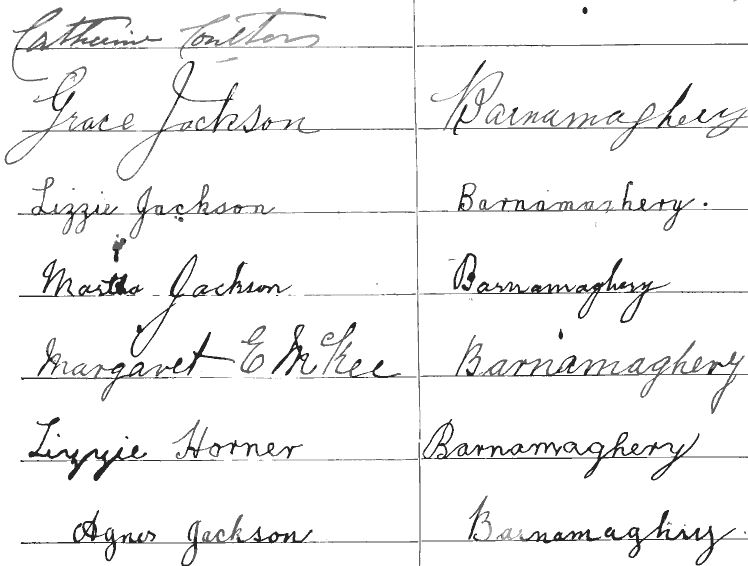
The McKees and Jacksons were among those who were opposed to Home Rule. Men and women signed separate documents in many areas but seemingly not at this location. These are shown below.
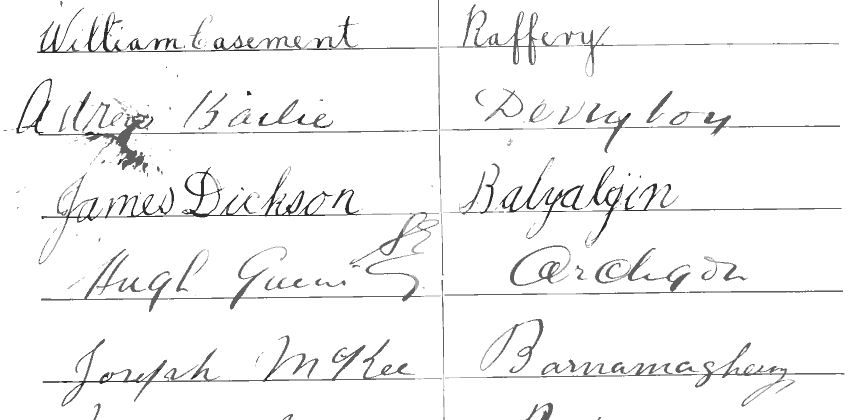
Below is an excerpt of the female signatures. This includes Joseph McKee’s wife Maggie formerly Jackson.
Family of John Jackson and Jane Miskimmin:
- Rachel Jackson, born 1855
- Martha Jackson, born 1856 and died 1915
- Susannah Jackson, born 1858 and died 1885
- Robert Jackson, born 1860
- Alice Jane Jackson, born 1861 and died 1900
- Margaret Elizabeth Jackson, born 1863 and died 1922
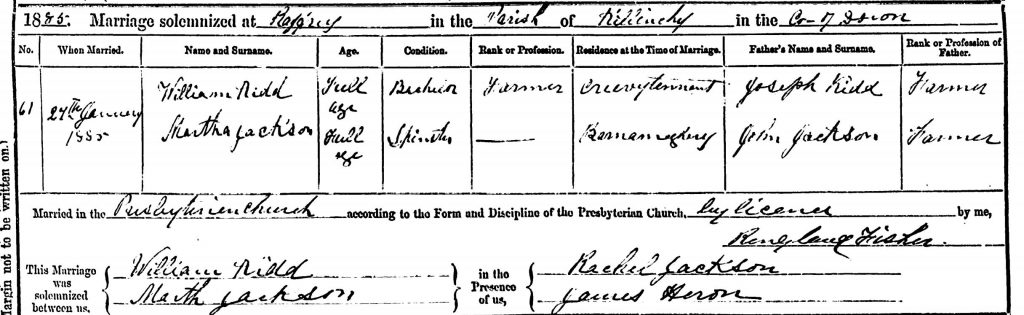
Martha Jackson was present when her mother Jane died in 1884. She married a Creevytennant farmer named William Kidd in 1885. The wedding took place at Raffrey Presbyterian Church.
Here is the family on the 1901 census.
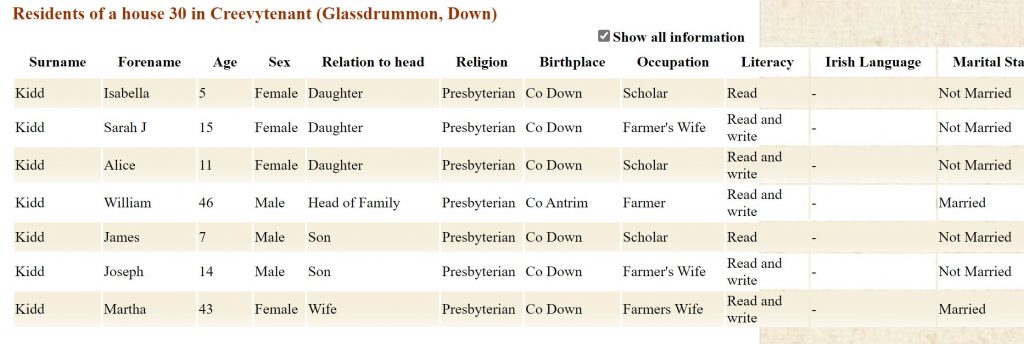
The Kidds had 6 children, but 3 died before the 1911 census. The 1901 census indicates that the family were Presbyterian.
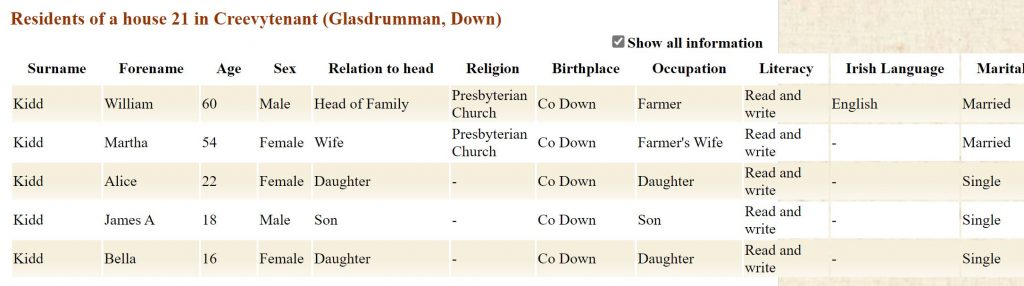
The 1911 census shows that Sarah Jane and Joseph had both died.
Sarah Jane was born on 18th June 1885:

The second child was baptised Margaret Alice Kidd, born on 23rd February 1889 but known as Alice according to the 1901 census.
Alice married Joseph Coulter at 1st Boardmills Prebyterian Church in 1926:
Joseph Kidd was born on 10th January 1887 but died of TB in January 1905 at the age of 18.

Next was John in 1891.

James Kidd came along in 1893.
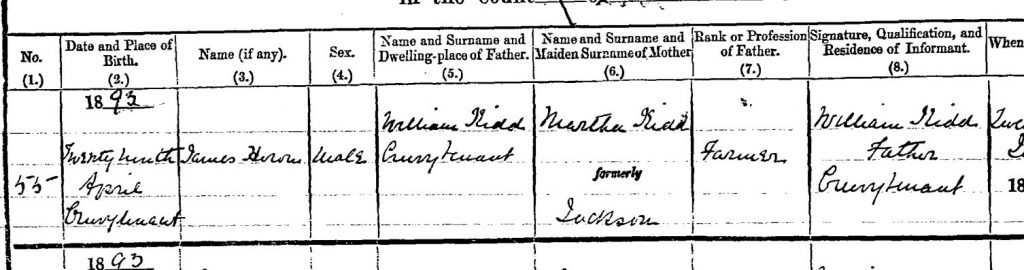
The final child to the Kidds was a girl named Isabella. She was born in 1895.

Martha Kidd died aged only 58 on 29th November 1915. Her son James registered her death.

Husband William Kidd was to die on 29th May 1924. The will index shows that he left estate of £201, probate granted to Rev John Lindsay McCandless and James Heron Kidd, farmer.
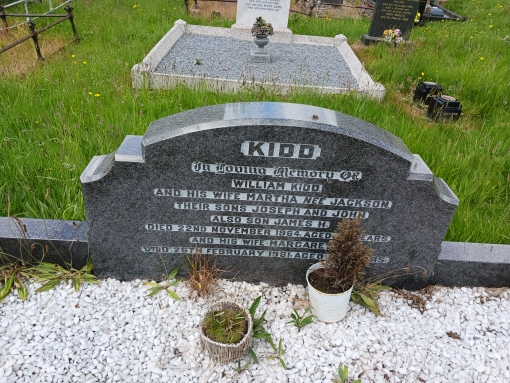
The couple were buried at Boardmills 1st Presbyterian Church graveyard, actually not far from a large memorial to the McKee family. Image: author’s own
James Kidd was mentioned in newspapers for a variety of reasons. The first was an unfortunate one, in the Belfast Newsletter of 19th November 1926.
He appeared at Ballynahinch Petty Sessions charged with having sold inferior quality milk on 6 occasions, leading to a fine.
The Belfast Telegraph of 1st November 1943 contained an advert by Mrs Kidd of a letting opportunity: “a well-built stone bungalow” 5 minutes walk from Ballynahinch.
The Northern Whig of 3rd March 1943 included a report on the County Down Staghounds meeting referring to them being “hospitably entertained by Mr Kidd, a really good sportman.” The same paper had referred in 1939 to Mr Kidd being a hospitable host to the Hunt.
James was a juryman on the inquest in 1927 regarding the death by drowning of a Creeytenant farmer named William Simpson. The newspaper noted that the jury were no longer required to view the body at inquests.
The will cannot be viewed but James is the same James Heron Kidd who died on 22nd November 1964. His home was Bowlough House, Creevytenant. He left £4352-10 s to Maurice Burnside Kidd and William McConnell Kidd, clerks. I presume these were his sons. James is buried with his parents.
There were two Belfast Newsletter death notices on 27th February 1981 for Margaret J Kidd, wife of James Heron Kidd of Creevytenant at her home at 19 Creevytennent Road, Ballynahinch. Her daughter Alice and son in law Harold McNally placed one notice on behalf of themselves and grandsons Ivor and Clive.
The other was by son Maurice and daughter in law Lily and their children Brian and Sharon.
The Dromore Advertiser carried an article about a Miss 1963 competition held in the Orange Hall. Alice Kidd was a participant.
Connections between the Kidds and the McKees continued via Christmas cards into more recent years with Alice Kidd keeping in touch with Joan McKee.
Turning to Martha Jackson and William Kidd’s daughter Sarah Jane, she married James McNeely, farmer. The couple moved to Barnamaghery and that is where their three children were born.
The first was Joseph William McNeely, born on 9th February 1912.
The next child was a daughter named after her grandmother, Martha Jane McNeely. Her birthdate was 14th May 1914.
Finally, Margaret Shaw Kidd was born on New Year’s Day 1919. All the births were at Barnamagery.
There is a DNA connection between Joan MacKee and people linked to the Kidds in some way but I have not managed to work out quite how yet.
A Thomas Rush born in 1844 and who died in 1904 married a Sarah Ann Kidd. She was apparently born in Scotland in 1857 and died in Manchester Connecticut in 1916.
According to a tree on Ancestry this couple had a daughter named Jane Rush, 1872-1918. Jane married a John Mitchell in (1856-1931) and they had a daughter named Bessie Mitchell (1897-1985) who in turn married George Hiram Elder (1897-1990).
Their daughter was Jane Elmer (1924-2024) and she married Edward Henry Godley and they had a daughter labelled JG who has 35 cM in common with Joan MacKee.
I have not been quite able to verify all this information myself: the American parts look correct but Thomas Rush might actually be Thomas Rusk. I have found his marriage and the birth of a daughter in 1873 named Jane the mother was not named Kidd or even Sarah for that matter: she was Margaret Kirkwood. I searched in Scotland’s OPR and state records for a marriage of Kidd-Rush and Kidd-Rusk without success.
However, there was a marriage of Sarah Ann Kidd and Thomas Rush in 1878 and they were both living at Creevytenant. In fairness, the person posting the tree on Ancestry has said that this was the year of their wedding. The wedding was on 26th February.
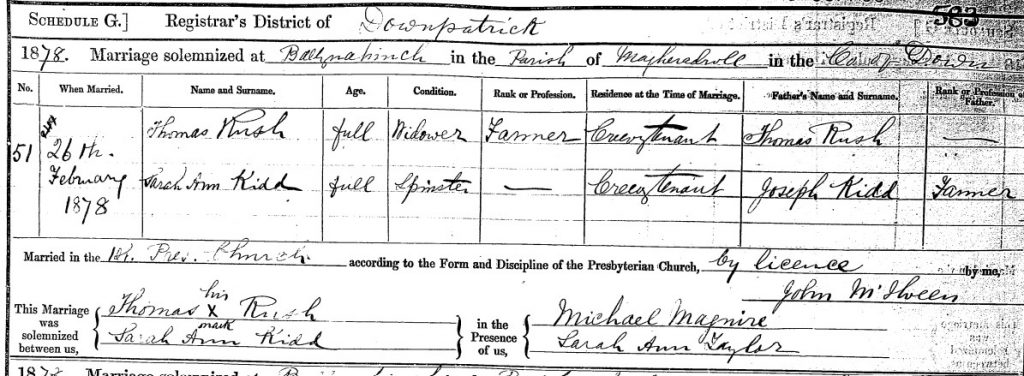
Sarah Ann’s father was named as Joseph and he was a farmer. I have not had success at finding his marriage which would be helpful in fitting things together but I did find the death of Joseph Kidd on 12th July 1875. He was thought to be 70 years of age, ie born around 1805.
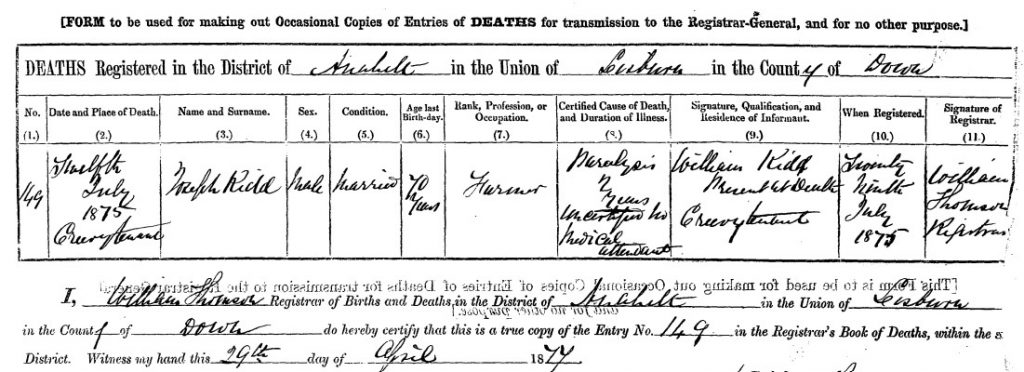
Note that William Kidd registered the death. Is this the same William who married Martha, ie Joseph is his father? This is certainly a strong possibility. In that case, Sarah Ann Kidd is likely to be the sister of William, thus explaining the DNA link to Joan McKee.
So what is my difficulty? “Jane Rush” born in 1872 or 1873. Her parents on the tree are at variance with her parents at birth registration. I think that she was perhaps given to William Rush and his wife Margaret Kirkwood to raise, perhaps because Sarah Ann was unmarried.
I suppose that William was a relation of Thomas Rush.

Minnie Jackson and her family
As related above, Minnie Jackson was a neighbour of Joan McKee as a child. Joan related that she lived with her brother and that Minnie took in a man named Cunningham and his three children after their mother died.
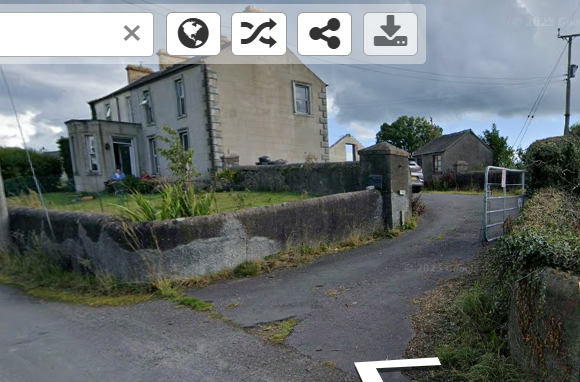
As a girl Joan would help one of the girls, Peggy, as she fed the hens. Below are photos of the house from Streetview. The death notice for Minnie below tells us that the house was called Laurel Bank. My thanks to Lily Cleland who was able to help me distinguish this house from The Bank.

Minnie died at the house in February 1953. Below are death notices from the Belfast Telegraph:
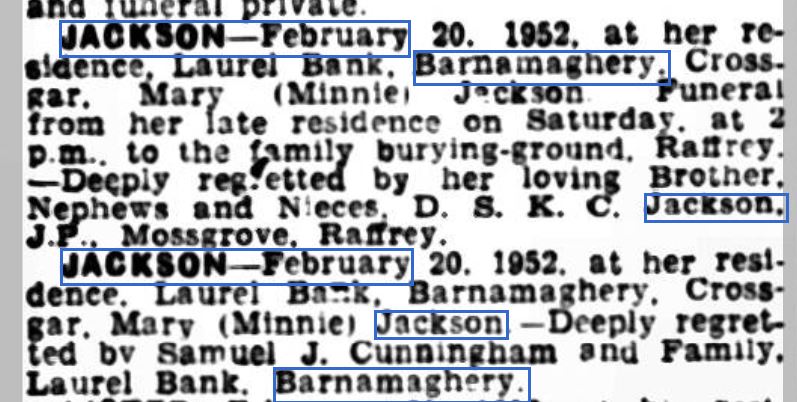
She left a typed, very detailed will itemising surely everything she owned and to whom she was leaving it. The will had been written a few years before as it is dated to the end of November 1948.
Minnie spelled out who relations were and what she was leaving them. Thus, her niece Mrs Elizabeth Coulter Dickson received both money and many items, Elizabeth’s daughters Mary Jackson Dickson and Margaret Rose Dickson received money as did another niece, Mrs Agnes Orr Gibson. She also makes bequests to the daughters of her nephew John Jackson, Sarah Jane Jackson and Mary Martha Jackson. Estate not specifically bequested to named people went to another nephew, John Coulter Jackson.
Minnie was generous to the Cunninghams, with money left to Annie, Alice Margaret (Peggy) and Samuel.
The excerpt here illustrates that Minnie must have been a very precise and ordered woman: “To Mrs Agnes Orr Gibson 3 tablecloths and towels, one cut glass butterdish, one silver tea service and plastic tray, six fruit dishes, Biscuit Barrel, sandwich plate…”
It is amusing to read instructions regarding her Austin 8 HP car, which John Coulter Jackson was to have first offer of at 3/4 of the market value.
Minnie was the second youngest of seven children born to Samuel Jackson and Eliza Coulter. This couple had married in July 1863. Note that Samuel’s father was a Barnamaghery farmer named Robert Jackson. I believe that this is the same Robert Jackson who was father to the John Jackson who was grandfather to Joan McKee’s father.
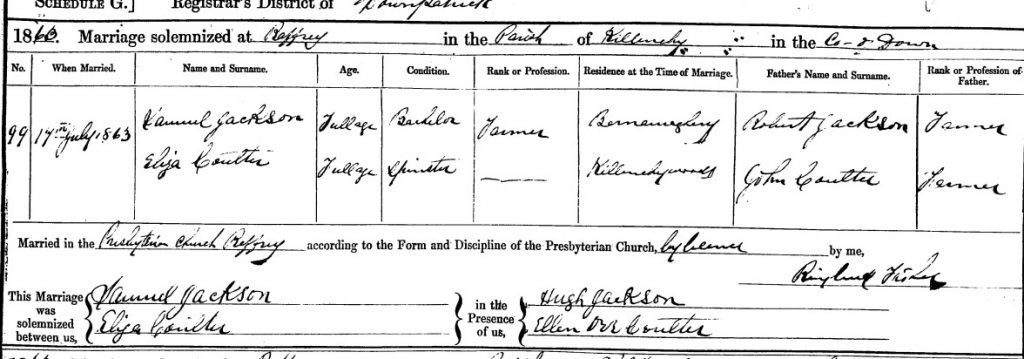
Minnie’s birth record is below:

She was born in 1874 with a sister, Agnes born two years later. An elder sister had already died. The girls surely remembered little of their father as Samuel died in 1879.
Family of Samuel Jackson and Eliza Coulter:
- John Jackson, 1864-
- Robert Jackson, 1866-1942
- Ellen Jane Jackson, 1868-1872
- Martha Jackson, 1870-
- David Stewart Jackson, 1872-1961
- Mary Jane (Minnie) Jackson, 1874-1953
- Agnes Jane Jackson, 1876-1885
Samuel left a will which can be quite hard to read due to the slope and the large letters.
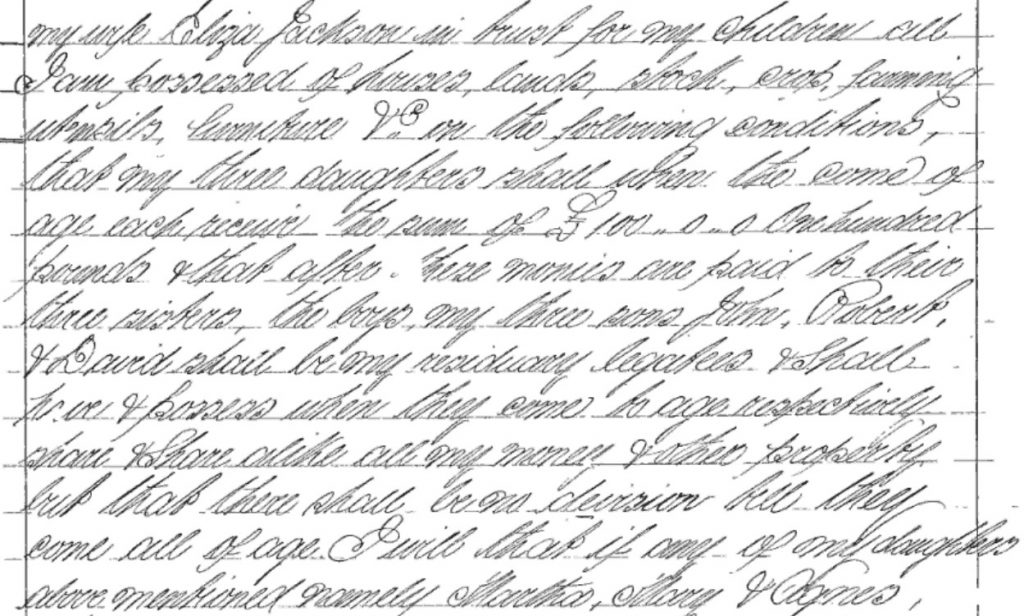
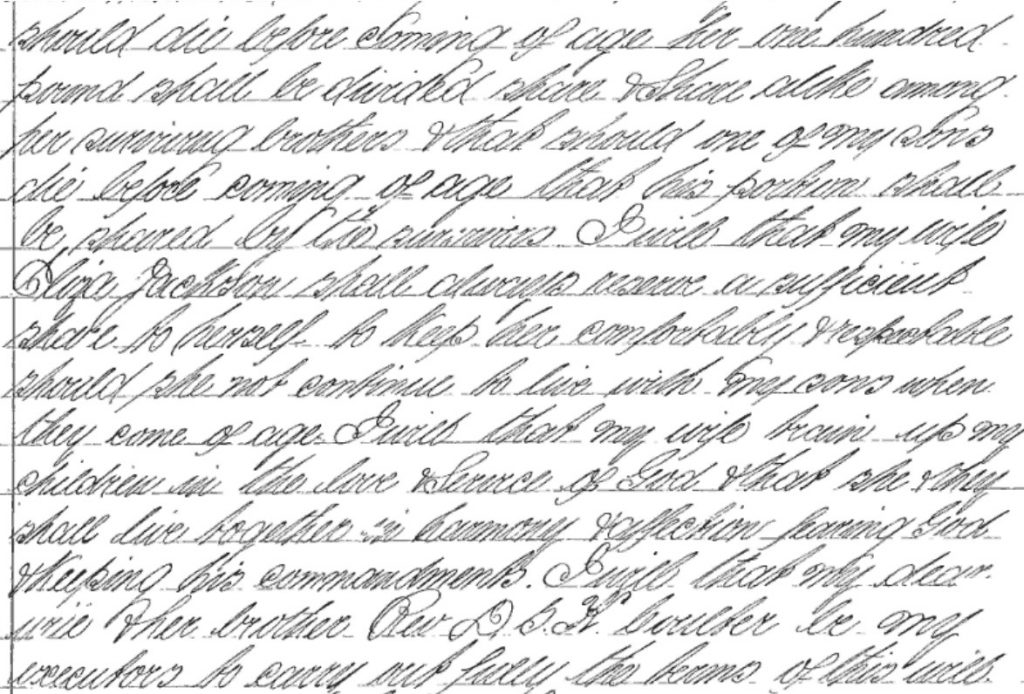
The will makes clear that he has three sons and 3 daughters still alive but under age. He left provision of £100 to each daughter for when they came of age. According to a reckoner on the internet this is equivalent to £3414 in April 2026.
I have little information as yet regarding the eldest child, John Jackson. This is due to the difficulty distinguishing with certainty between people with the same name.
The second child, Robert Jackson, was born at Barnamaghery.
He was to marry Grace McBratney in April 1893 and together they had 8 children. His sister Minnie was a witness at the Saintfield wedding.
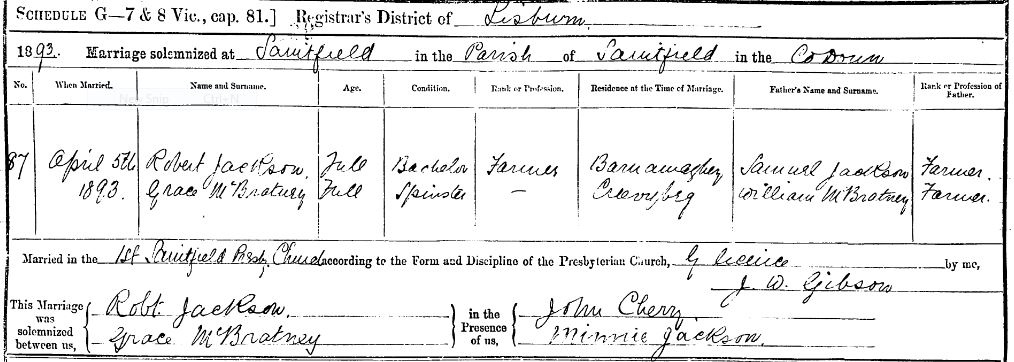
Information about his family will follow below.
Ellen Jackson lived only a few years, dying in 1872. The next child was Martha. Her father’s will indicates that she was alive in 1879 but I can say nothing of her beyond that.
David Stewart Jackson was born in 1872. He added a couple of names when he married Mary Orr in May 1903. David went on to live at a house called Mossgrove in Raffrey with his family and he was one of 45 new magistrates appointed in 1935 so he must have been an upstanding and reliable person.
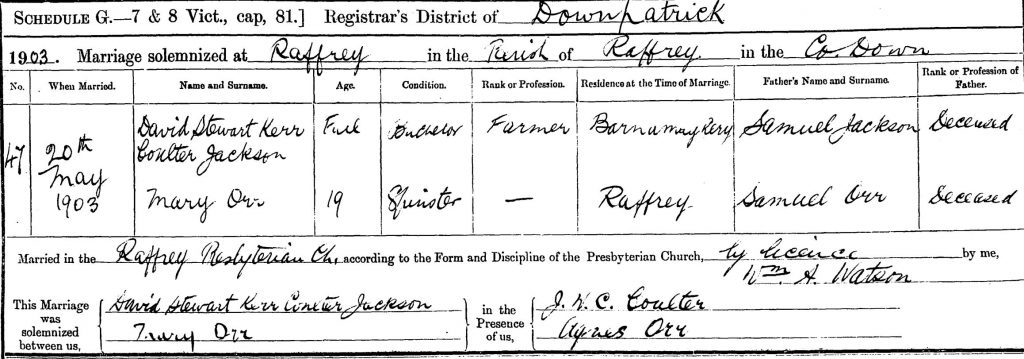
The Family of Robert Jackson and Grace McBratney
As shown above, this couple married in 1893. They were to have 4 children together.
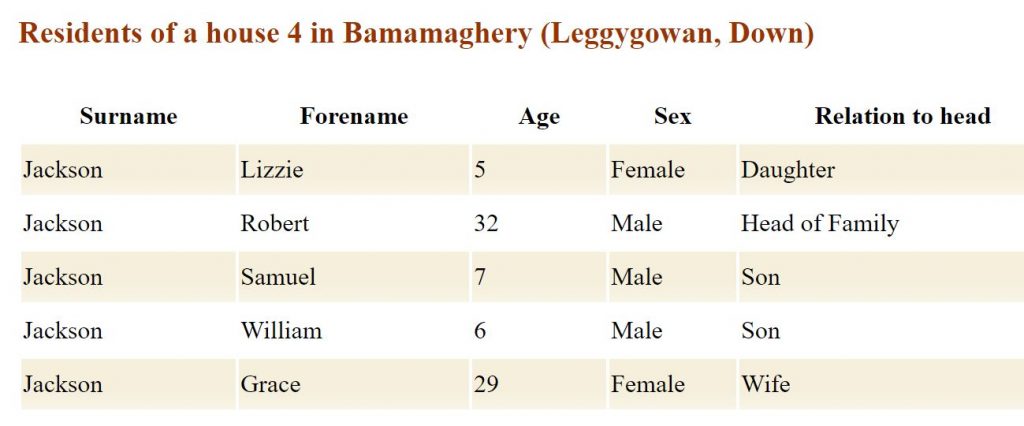
This branch of the Jacksons lived at a house known as The Bushes but I do not yet know where that was. Robert died in 1942. Here is the family from the 1901 census. Whether this was The Bushes or an earlier house I cannot say.
In 1911 the family were at house 10. This could be the same house with enumerator following a different route, a new house or the same house with a couple of new houses built in the previous ten years. The couple said they had had four children,
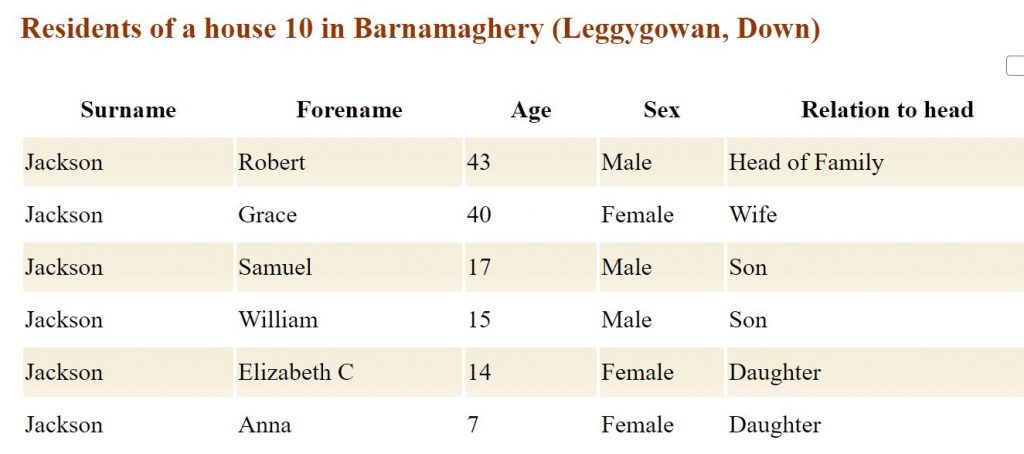
- Samuel Jackson, 1893-1964. He married Marjury [Marjorie later] Martin and they had a son named Robert. Joan McKee has 11cM DNA connection to this Robert’s daughter according to Ancestry.
- William Jackson, born 1895 and who married Lizzie Martin.
- Elizabeth Coulter Jackson, born in 1896 and who married a William Jackson.
- Anna Jackson, born around 1903.
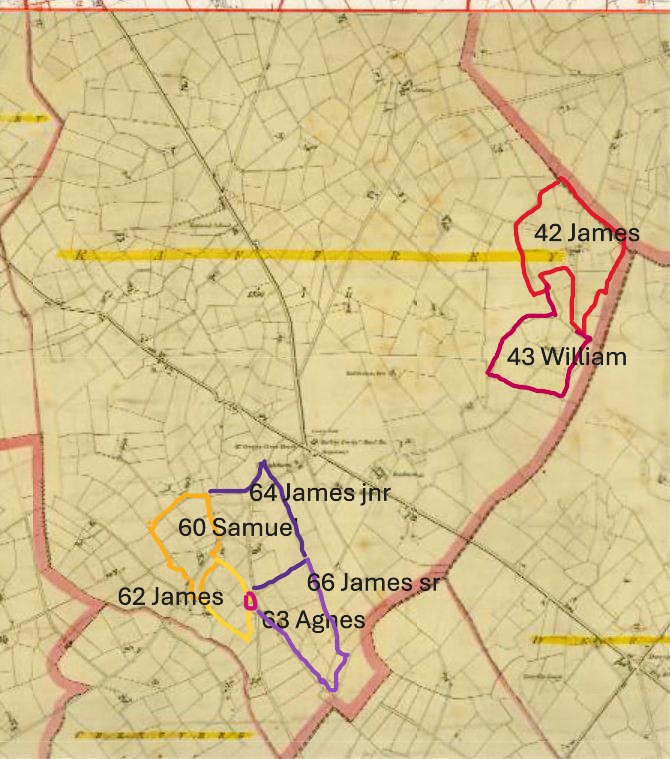
The map below, available at akaboutireland.ie, shows much of Raffrey townland in Killinchy parish. Using the original landholding maps from PRONI I have added as best I can the holdings of several members of the wider Jackson family (families).
According to Griffith’s Valuation these were James at 42 and William at 43, suggesting that this was originally all one farm, perhaps under their father.
62, 63, 64a, 64b, 64c and 66 are all contiguous. Agnes at 63 held a house only. She may be a sister or daughter of John Jackson senior who held 66. His son John Jackson junior farmed the land at 64a and was the lessor of 64b and 64c, thus acting as a middleman for the Marquis of Downshire in effect. A James Jackson was at 62. He may have been a brother of John Jackson senior or another son.
The McKees
It would be possible to spend many pages, chapters, on the various Jacksons of Raffrey but I lack incentive to do so. It is my contention that all the branches will conjoin in the 17th century. The Silver Bowl website is an excellent resource for those wishing to explore further.
Let us turn to Joan McKee’s father, John Jackson McKee. It was shown earlier how he was born at Barnamaghery in 1899 to Joseph McKee and Margaret Elizabeth Jackson. This couple had married at Barnamaghery in 1898. Joseph said his father’s name was Hugh McKee. Here are the two certificates again for convenience. Note that one witness was a James McKee. This could be a cousin or an uncle, though it might even be a brother whom I have not identified as of May 2026.

It is interesting to note that it seems to have been John Jackson McKee’s grandfather who registered his birth in 1899.
As shown in the Jackson section above, Joseph McKee took over the farm of his father in law on behalf of his son.
Joan McKee knew the family came from Boardmills, which is not far from Barnamaghery, being SW of Crossgar and in Killaney parish.
According to Irish civil service records extracted from census information prior to their destruction, there were 464 people living in Carricknaveagh’s 969 acres in 1841. This fell to 385 by 1851 and again to 332 by 1861.
In 1841 the townland held 82 houses, declining to 72 in 1851. By 1861 there were just 63 inhabited houses and 3 unoccupied houses.
Usually marriage certificates say if the father of either part is dead, but Joseph McKee’s does not.
However, we have a huge clue from the following, the registration of the marriage of John Jackson McKee to Elizabeth Florence Patton (now Perry after her first marriage).
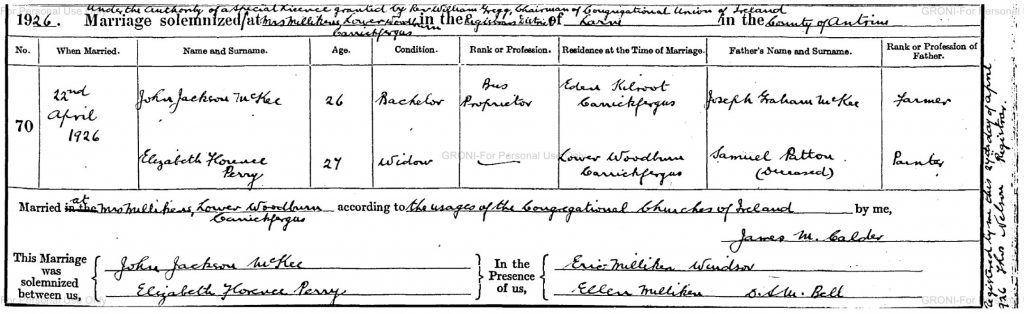
John had his mother’s maiden name as a middle name and seems to have presumed that his father had been given the same accord. In fact none of the documents available show this but it did suggest that I should look for a McKee- Graham marriage.
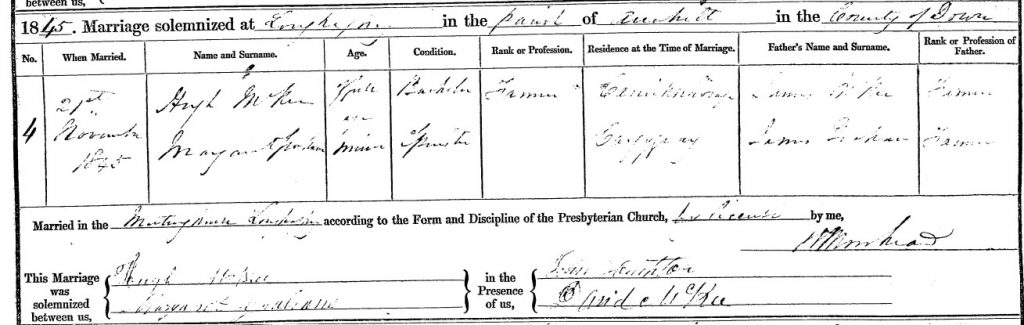
There is only one registration of a McKee-Graham marriage. This was in 1845 so children from the marriage are unlikely to have been registered other than by a church. Margaret Graham was a minor, ie under 21, from Cargygray. Her father James was a farmer.
Cargygray is one of 11 townlands in Anahilt parish. The townland is 468 acres in size.
Hugh McKee was of full age and a bachelor. He was a farmer from Carricknaveagh. His father was a farmer named James McKee. An Andrew McKee was a witness to the wedding.
There is no sign of Hugh on the Rates Valuation Books at that time. Only the first book, which started in 1866, shows Hugh’s name. It has a line through it and the name James McKee replaces it. This indicates that Hugh was dead then. It is of course possible that this is a different Hugh but I do not think so.
Hugh almost certainly died in May 1865, a year after state registration of deaths became law. The certificate below shows that a Hugh McKee of Carricknaveagh, farmer, died of a tumour (or a fever) and a Margaret McKee registered the event. If accurate, he would have been born around 1815 and therefore around 30 when he married.
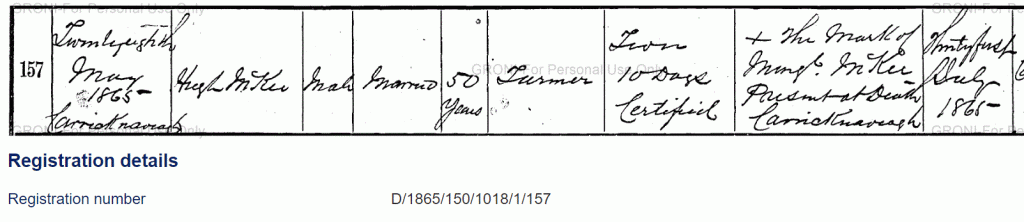
I have been in touch with a nice lady from the now combined churches at Boardmills but there appears to be no recorded burial of Hugh at any of these.
Hugh McKee, unfortunately, left no will to help clarify his family but it seems clear that James and Hugh were his children. Whether the Andrew who witnessed his wedding was a brother or other relative may be established in time. Or not.
Wading through microfilm records at PRONI in August 2022 I noted in MIC637/3 a list of McKees in Killaney Parish. This included 5 names: Brice in Carrickmadenow 1852; Hugh in the same 1746; Hugh in Carricknaveagh 1849; James in Carrickmaderow 1817 and Thomas in the same in 1784. Others are listed from the tithe applotment book for Saintfield in 1834. This does not include a Hugh and no names for Carricknaveagh as such. There is also a list of 10 McKees from various townlands and the number of acres held. This included 3 named Hugh (it could be the same man, of course, with 3 separate holdings. These were 6 acres in Leggigowan (sic), 12 acres in Lisdoonaw and 19 in Oughley.
James was living and farming at House/land 34, Carricknaveagh. The map below from Griffith’s Valuation shows the location close to where the Saintfield Road meets Temple. There seem to be 11 fields, a house and two outbuildings.
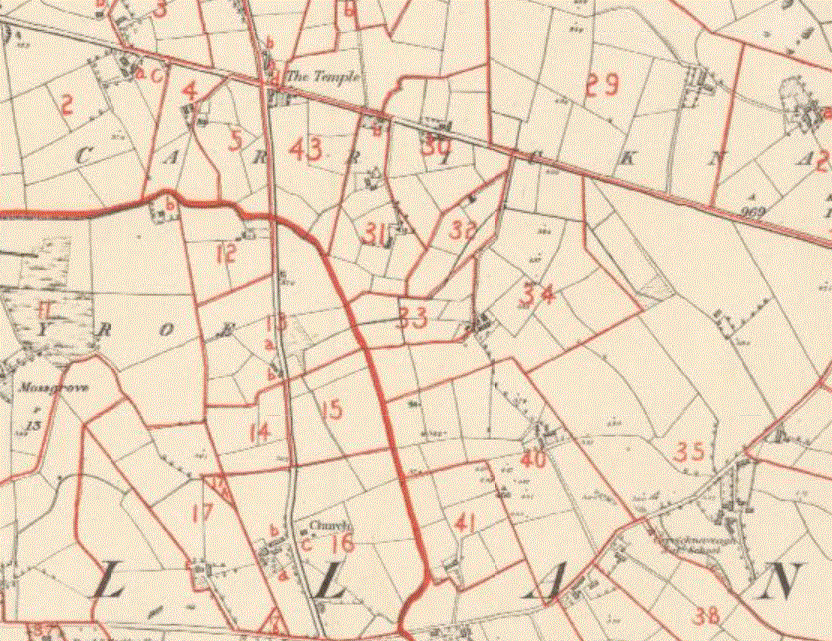
What I did not know was whether this is Hugh McKee the father of Joseph McKee with a transfer of farm to his son James (whose will is below) or whether it was the land of James McKee of Poagsburn (which is in Carricknaveagh). Update September 2026: as I have identified where Poagsburn was (some fields away at 21 on the map it seems more likely that this is in fact the father of Joseph McKee at 34.
May/June 2026 Update
The will of a James McKee who died in 1937 can be viewed at PRONI and I have done so. This James was a bachelor with no living parents, grandparents, spouse or children according to the written oath declared by his executors.
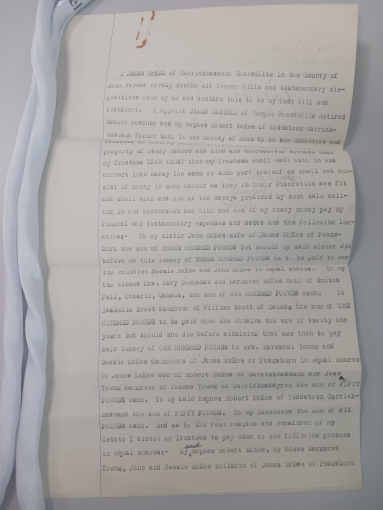
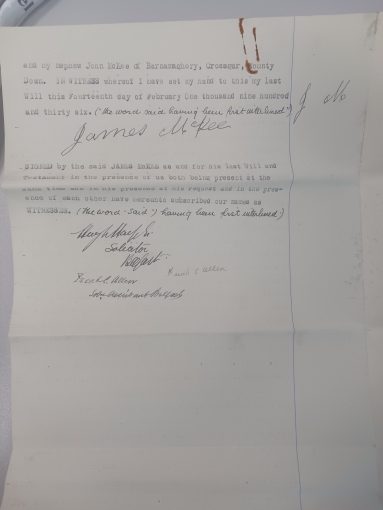
Crucially, the second page refers explicitly to his nephew John McKee of Barnamaghery. This is surely a different person from the John McKee referred to as the son of Hugh McKee of Poagsburn and it is also certainly Joan McKee’s relative given the Barnamaghery reference.
Here is the death record for him, registered by his nephew Robert McKee:

It is possible to establish that Hugh McKee married Margaret Graham in 1845 as shown above.
They went on to have family as follows:
- James McKee, died September 1937
- Joseph McKee, born around 1863
- Jane McKee, born August 1864, who married James McKee of Poagsburn and died in January 1945
Update 3rd June 2026: I have managed to look through the parish records of Boardmills 1st Presbyterian Church at PRONI, which was formerly known as Killaney Church.
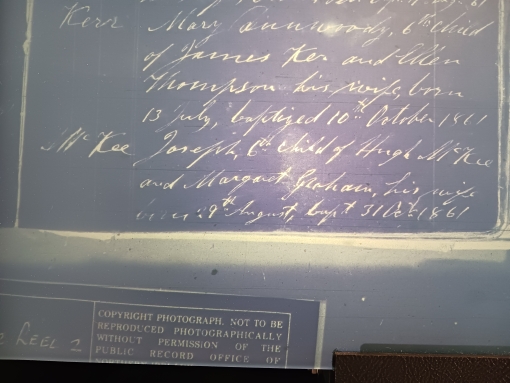
As a result I have been able to verify the following family of Hugh McKee and Margaret Graham:
- Isabella McKee, born 1847
- Eliza Jane McKee, born 1848
- James McKee, born 1851 (died 1937- will above)
- David McKee, born 1853
- Margaret Prentice McKee, born 1858
- Joseph McKee, grandfather of Joan McKee, born 1861
- Jane McKee, born August 1864, who married James McKee of Pagsburn as stated above.
From this we can see that James McKee was the eldest son and thus probably inherited the whole farm or the larger portion of it (if it was shared with his brother David).
I think that Margaret McKee (nee Graham) was alive in 1901 and living with her son James at House 20, Carricknaveagh, as shown by the following census entry:
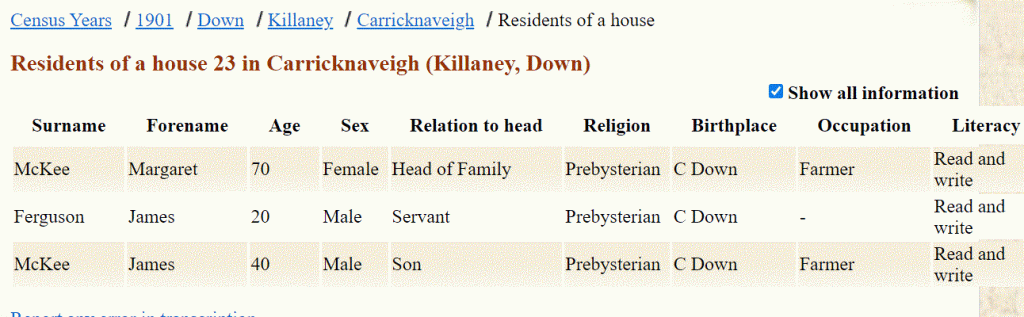
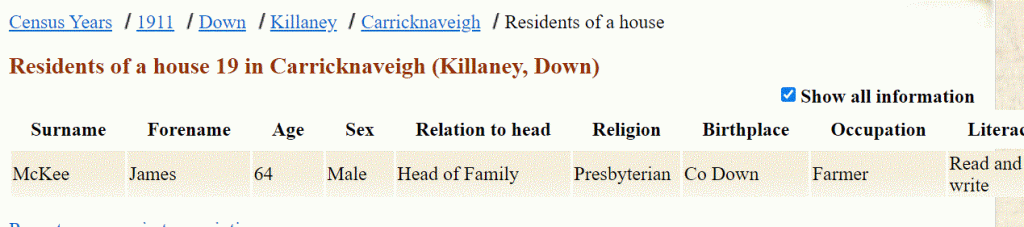
If I am correct then James’s age has been under-reported as he was around 50 at this time, not 40. Of course, the handwriting may have been difficult to understand and then transcribed wrongly.
Again, if I am correct, there was no other family member present and helping on the farm; David had his own family and Joseph was married and living in Barnamaghery by 1901.
Does the name “Margaret Prentice McKee” give a clue as to Hugh McKee’s mother’s maiden name? Certainly there was at least one other McKee given this name which suggests the possibility. However, a David McKee married a Margaret Prentice and they had several children together between 1834 and 1851 and the name Margaret Prentice McKee for one of Hugh’s children may reflect no more than a fondness and respect for her. At present I cannot make a clear connection between these branches.
The good news is that the Boardmills records go back to 1784 and include many McKees. The bad news is that reading them is difficult eg 8s that look like the infinity symbol, 4s that look not like modern 4s, 0s with a tail in the air.
Still, it might be possible to identify the parents of Hugh, his own birth and his siblings among those records are possibly among the Anahilt records.
Another problem I have found is that Presbyterian records of marriage are no more than the two names and the year along with the parish each lived in. No parent or even a townland!
Poagsburn McKees
The will of James McKee above refers to nephews and nieces via James’s sister Jane who married James McKee of Poagsburn. Poagsburn is a farm and farmhouse situated in Carricknaveagh townland. I have identified this as 21 Carricknaveagh on Griffith’s Valuation map.
A search for it on the internet will also bring up information about a McKee family, that of a Hugh McKee, and their involvement in the 1798 Rebellion in County Down. See below. This is a separate Hugh McKee.
It is also likely to lead to information about John McKee who moved to America and did well for himself as a merchant; John did not marry and donated a lot of money to allow Boardmills 1st Presbyterian Church to build a new hall.
Family of James McKee of Poagsburn and Jane McKee:
This couple were living at House 20 on the 1901 census and House 29 on the 1911 census. The change of number does not mean a change of address but possibly the addition of some more houses in the townland and or the enumerator taking a different route through the area from the last time.
- Margaret, born 27th January 1891. Possibly married William Moorhead at Loughagy, Anahilt on 21st May 1921.
- Robert, born 21st December 1894
- Isabella, born 7th May 1896. She married William Edgar Scott at 1st Boardmills Presbyterian Church on 30th August 1918.
- Jane, born 13th February 1900 and died 14th September 1900
- John, born 21st June 1906
- Martha Elizabeth, born 1st June 1905 (known as Bessie)
The 1911 census asks how many children have been born alive to a couple and how many are still alive; as a result we may be sure that there were no other children born prior to spring 1911.
Joan Mckee is able to remember visits to John and Robert with her father when she was young, prior to WW2 or during it. They lived together and John must have been married as he had a daughter named Molly. Joan recalls Molly having a horse. They were of a similar age, indicating that Molly was born around 1935.
Using the old Ordnance Survey maps available free courtesy of the National Library of Scotland and Griffith’s Valuation maps and records I have pulled together a map showing the properties held by the McKee family at least in 1864.
Most of the farms and houses are in the parish of Killaney but part of Bresagh is actually in Saintfield parish.
This first image is a screenshot from Griffith’s maps with Carricknaveagh at the centre; Saintfield is just visible at the bottom right, with the demesne of Sqyure Price above. Note that we have been lucky to have a collated map as Saintfield is unmarked with boundaries and numbers. The townland of Carrickmadderow is to the left of Carricknaveagh. Oughley is at the top of the marked area (a James McKee held 22 there and a William held 26 and 27. Sadly, these are just outside the range of the image).
Bresagh is to the SW, ie the bottom left of the image, with a little of Lough Henney just visible.
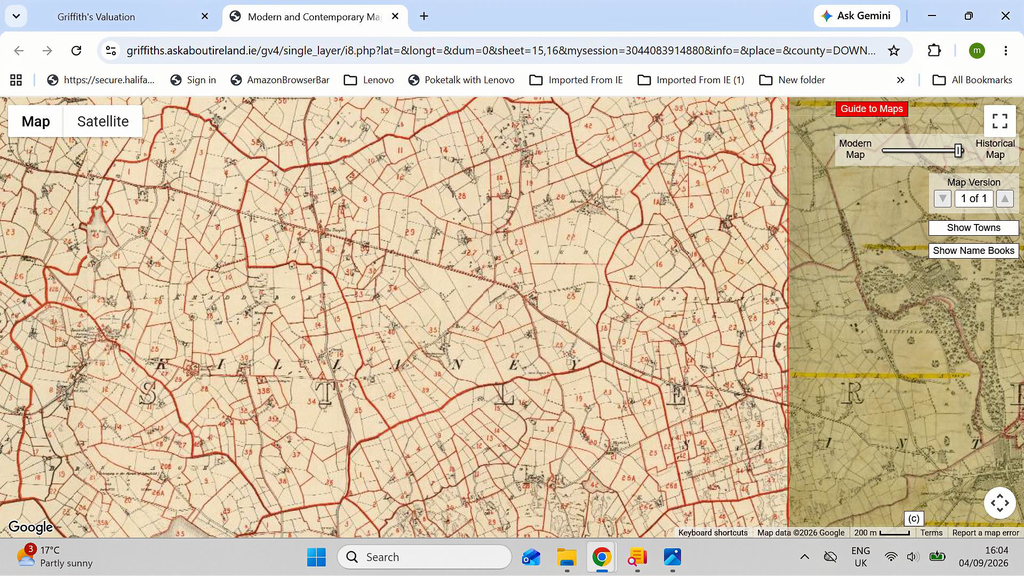
The map below, then, shows the marked areas. One area (30 Carrickmadderow) was outlined by mistake- it was challenging to read the numbers at times. The grey lined areas in Bresagh were held by assorted Edgar people, listed further below.
I had to open Paint to add the text showing the area number and Christian name of the McKee listed in Griffith’s Valuation. This was done in black. I thought it would be helpful to readers- it certainly was to me- to have the townlands marked more clearly as well, which I did in blue italics. Perhaps I could have used a larger font but I wanted readers to be able to see numbers, boundaries etc for themselves.
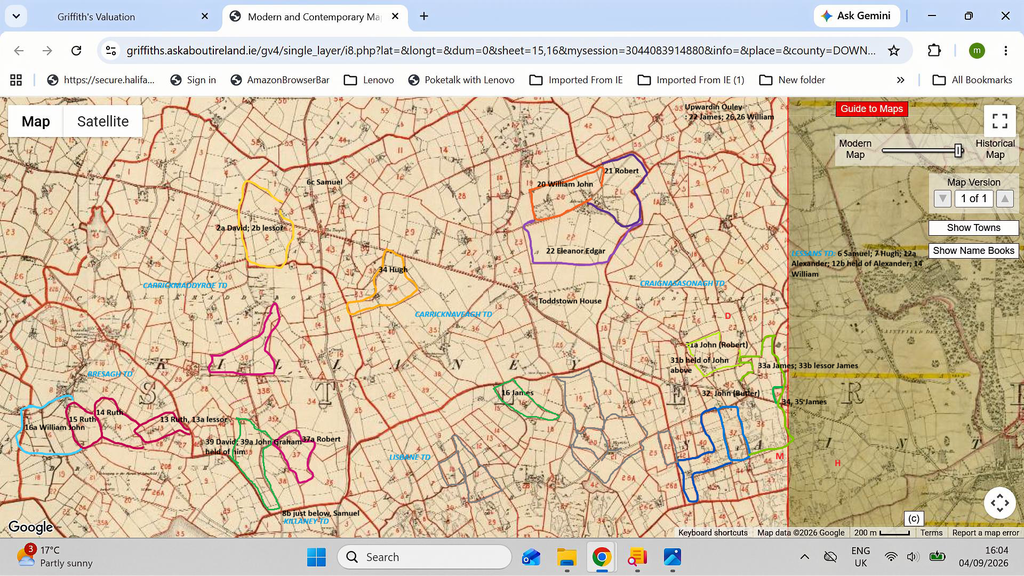
Let me draw your attention first to Area 20 in Carricknaveagh, bordered in orange. This was farmed by William John McKee. The lilac area of 22 below was held by Eleanor WC Edgar and I believe she was a close relative. In purple is 21 which was held by Robert McKee. These three farms form a coherent unit and Robert McKee’s farm was Poagsburn, referred to above. Beside it is a farm called Ashvale but it is unclear from the map whether it is the farm of Eleanor Edgar or of William John McKee.
As well as Poagsburn House I have also marked Toddstown House.
The Edgars of Lisbane were:
10 Robert (John) 6 acres
11 Robert (Robert) 15 acres
19 Robert senior 22 acres
21 Robert senior 25 acres
22 Robert 3 acres
There was also a Jane Edgar holding 15 acres at 9 Killaney TD, just to the south of the map and adjacent to the Killaney graveyard and the lake.
A Useful Source? A Red Herring? Or Both?
“A History of the Descendants of David Mckee of Anahilt: With a General Sketch of the Eary Mckees” by Professor James Y McKee was published in Philadelphia, US in 1892.
This book is available to view online and there is a photocopy of it in the library of the Ulster Historical Foundation at Kiltonga, Newtownards. The Reverend David Stewart of Boardmills 1st Presbyterian Church who did so much to preserve and clarify the records of the church by going back through them, refers to this publication in the pages of the church records. He also speaks unfavourably with regard to the Irish section of the book, which is most unfortunate. This is especially the case when we cannot be sure of exactly which aspects and how many aspects he regarded as unproven or disproven.
“In the portion of this work dealing with the Irish Mckees many statements are erroneous, so numerous in fact as to make the publication untrustworthy. I have several original documents beside this copy of Boardmills Registers, which reveal this.“
The Reverend David Stewart was a most methodical man and it is very unfortunate that he did not go into further detail. The margin of the church records is littered with his annotations and remarks; clearly he was a diligent man. I do not doubt that one section which Stewart regarded as untrue, and I would concur, is regarding Hugh McKee [immediately below] marrying a bridesmaid rather than the missing bride and said bride’s subsequent half curse upon Hugh and his family, and the detailed circumstances of their demise.
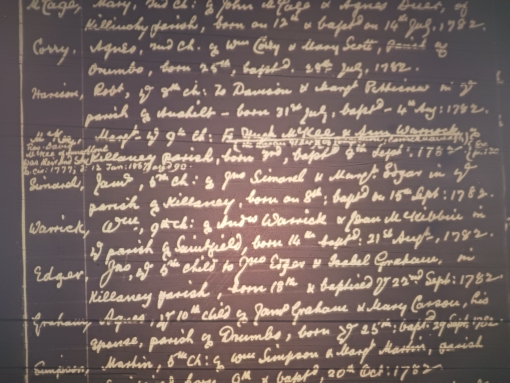
One example of Rev David Stewart’s meticulous work is below, a little blurry as it is a phone photo from the microfilm at PRONI.
Hugh McKee of the Burnt House and the 1798 Rebellion
In fact, several newspapers give a good amount of detail about the incident on Saturday 9th June 1798. This was at the start of the United Irishmen rebellion which took place in many counties in Ireland in the course of the year in a largely uncoordinated manner. The rebels were certainly numerous, for all that most Irishmen did not involve themselves, and had they been competently organised and led for military action would surely have caused much greater discomfort for the government than proved to be the case. To some extent they were undone by superior government infiltration of their ranks combined with swift pre-emptive action but it would be fair to characterise the rebellion as having been largely overcome by much smaller numbers of militia and yeomanry.
In wargaming terms these are not usually seen as terribly well trained units and the militia called out in 1745-46 against Bonnie Prince Charlie’s army did not shine out apart from one body of horse.
I will not go into the rebellion in depth as there are plenty of very good sources in print and online and I am pleased to say three wargames on the subject. There are also documents in the form of trial information and published books which give detail (sometimes at variance with each other) regarding Hugh McKee’s demise.
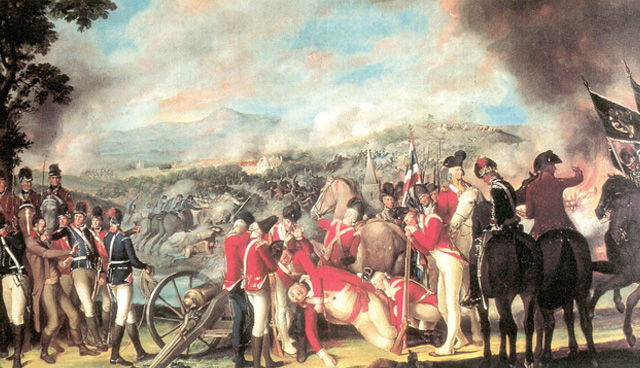
Illustration of the Battle of Saintfield, 10th June 1798, from the website agendani.com. The original, by Thomas Robinson, hangs in the building used as the residence of the president of Ireland.
The graveyard of the First Presbyterian Church in Saintfield includes marked graves of a few of those who fought and died in the battle and there are information boards around this area of the graveyard.
The following comes from the Salisbury and Winchester Journal of 15th April 1799. I have removed a considerable number of commas from the piece:
The trial of rebels at Downpatrick Assizes for the murder of Hugh McKee and John Boles his servant… Mr McKee had been a loyalist; that about two years since he prosecuted several United Irishmen for an attack at night upon his house one of whom was the prisoner Shaw… and some of his confederates but they were acquitted after a long trial.*
On the day of the engagement between the King’s forces and the rebels a party of the latter marched in regular order from Saintfield to Mr Mckee’s house and he hearing of their approach prepared with some of his family for his defence.
When the rebels came up he fired upon them and they retreated and sent to their camp for a reinforcement which having obtained they renewed the attack, firing into the house and at length after meeting with a bold resistance these desperadoes prevailed and set fire to the house.
When any of the family came to the windows while it was burning to endeavour to escape, the rebels fired at them to keep them within.
This unfortunate family together and all collected in a group at one end of the house, rebels rejoicing at the conflagration and hearing, unmoved, the lamentable and piercing cries of Mr Mckee’s children as they were burning to death,- while the house was in flames a man servant determined on a last effort to save his life made his way through a volley of fire and though wounded did not fall, until some of these barbarians pursued and most inhumanely piked him.
The unfortunate man lived for twenty four hours, not withstanding , after he was forced to tell the tragic tale of the destruction of his master and family. The prisoners were all found GUILTY.
The judge in summing up appeared careful to advise the jury, telling them that they needed to be certain that the accused had gone to the house intending to kill Mr McKee in order to bring verdicts of murder.
Saunders’ News-letter, published in Dublin, reported on 29th March 1799 and three men had been sentenced to hang and were executed at Downpatrick on 23rd March 1799.
Incidentally, there had been a temporary stop order on executions in 1798, as reported in the Belfast News-Letter of August 17th 1798, pending a decision in Dublin on how to proceed.
Those executed were William McCaw, William Shaw and James Breeze. One newspaper had reported that Hugh McKee had been a Yeoman. Most of the forces opposing the United Irishmen were people also born on the island of Ireland, including Yeomen and militia. Fencible regiments from England and Scotland also took part. Below is an illustration of a yeoman of the period.
I have not been able to locate the trial documents (perhaps these are held by the court service or have been destroyed) but did find a photocopy in PRONI of a damaged eye witness account of the last day or so of the three condemned men. Unfortunately the author is unnamed, though he gave religious succour to the men. The reference is D162/100B.
The opening refers to “fell as victims of the m? and the perjury …”
Wm Shaw, Wm McCaw and J Watson and James Breeze walked hand in hand …the psalms we sung in walking from the jail to the gallows were 23rd and 24th when they arrived at the awful ? of them kneeld and prayed
[after more singing and a reading] such embraced each other and separately took their leave of us all returning us three all thanks imaginable… for the services we had administered… then they stept up on the and Wm Shaw said he died for his country, he wished his family well for which reason he joined in one common cause intended for the common advantage of the country at large But although condemned for murder
There is damage to the top of the second last page so it is unclear who is speaking: “to murder not ever once intending murdering any of the sons of men nor fraudulently enjoying their Property but he died in peace with all men, he forgave his judges and jury and even him who swore falsely against him as he expected to be forgiven for his sins by his Lord and saviour Jesus Christ. Wm McCaw spoke a few words nearly to the same purpose.
Breeze “solemnly swore he never was nearer Mckee’s house than Lisburn Road which was at least quarter of a mile distant. He said it was sawrn [sworn] he gave orders to fire through the windows of Mckee’s house he solemnly declared he never gave orders to any body of men
*The earlier trial referred to was reported in the Dublin Evening Post of 9th May 1797. There had been an attack on Hugh McKee’s house and a number of men were in court. One had apparently been identified by his voice. Hugh’s son, James, had been giving evidence and was cross examined sharply as to why his father made him stay away from the windows; his testamony was doubted, however, when he was slow to admit that he had been in an adjoining room to the court with the Reverend John Cleland immediately before giving evidence. When pressed by the judge he eventually admitted that he had but claimed they had not spoken about the evidence.
The jury acquitted all the accused.
Cleland might be a brother of a yeoman officer whose men provided valuable assistance at the Battle of Saintfield to the York Fencibles.
A most useful 1998 Hearts of Down publication, 1798 Rebellion in County Down has been acquired by me (August 2026) and it contains further information and context on the McKee murders in a chapter by Gregory P Toner entitled The Battle of Saintfield.
For instance, Trevor McCavery in Chapter 4 relates that a meeting of magistrates in March 1797 agreed that County Down should be placed under the Insurrection Act with General Lake’s men conducting searches for weapons, disarming those holding weapons illegally and dispersing unlawful assemblies.
In Chapter 5 Gregory Toner describes how Squire Nicholas Price had shifted from being an active Irish Volunteer in earlier years to setting up a Yeomanry corps with support from Rev James Clewlow, his cousin. McCavery says this led to a hardening of attitudes amongst would-be insurgents.
According to McCavery, the home of Hugh McKee was at Carricknacessna. Insurgents from Saintfield, Killinchy, Comber and Knockbracken had assembled on the morning of 9th June at Cow Green in Saintfield then marched to Oughley Hill.
He relates that in spring 1797 Hugh McKee had accused several influential UI men of attacking his home. These were David Thompson of Lisdalgan, David and James Shaw of Saintfield and William Minnis of Lisdoonan. They were acquitted.
This, presumably, relates to the PRONI record I have seen where a witness was found to have been in a room with the minister or rector before giving evidence. There was a Belfast Newsletter note of the incident, claiming there was a reward offered for arrest of the men who stole a horse. The newspaper was dated 17th July. I found this on Find My Past Newspaper archive and Rev David Stewart refers to the same in the margin of the Boardmills 1st Presbyterian Church records.
Hugh McKee was “one of a handful” of Saintfield men who joined the Yeomanry led by Nicholas Price. McCavery makes use of a source I do not have direct access to by Reverend TL Birch, Letter from an Irish emigrant to his friend in the United States giving an account of the commotions in Ireland of the United Irishmen and the Orange Societies and of several battles and executions [Philadelphia 1799].
Birch was the minister at the First Presbyterian Church in Saintfield (where some of those killed in the subsequent battle were laid to rest). He is not an impartial recorder as he had founded the United Irishmen in 1792. According to Birch’s writing in the Morning Star newspaper, Nicholas Price only secured 20-30 people for the yeomanry, with 5 joining the cavalry. He reported gleefully that 2 had no horse.
According to Birch, the murders were not intended and resulted from McKee refusing to give up his weapons and McCavery notes that the rebels did not mistreat prisoners in the district.
He discusses the provenance of the killers eg that only one of the eleven charged was from the local area, following Birch in this. Birch blamed a Killinchy man, Samuel Hewitt. This is at variance with what some witnesses said of locals, however.
For instance, Catherine Quinn deposed that she had seen Charles Young and Betty McCall that she saw James Shaw of Saintfield dressed in a green jacket as well as local surgeon John McKibben with a pistol. Betty McCall gave hearsay evidence against a fiddler named Orr who lived on the road between Saintfield and Killyleagh.
Birch only mentions Samuel Hewitt by name and McCavery notes that by the time he wrote his letter Hewitt had become a prosecution witness. He suggests that Birch was seeking to discredit Hewitt in his letter.
In 1799, however, 12 men were executed for the McKee killings, including Hewitt. A James Gardner of Lisdalgan and Charles Young of Saintfield also turned witness, giving evidence against the twelve.
James Gardner accused eight of the men of involvement. Charles Young was alleged to have set the roof on fire and may have been anxious to save himself.
In the end, a man named William McCaw of Carricknacessna was found guilty. Neither informer had given evidence against him according to McCavery. He was executed.
McCavery says that both men shifted responsibility onto outsiders, perhaps because they would have to go on living among this community if the men were executed (P106; I paraphrase).
McCavery notes that the government made use of the incident “as part of the propaganda war waged against the insurgents”, quoting Birch as saying, “Hugh McKee is the person, whose self and family were burned in the house near Saintfield, which has been retailed in the newspapers, and trumpeted up by the British partisans, as a heavy charge against the United Irishmen“.
A local man, Andrew Todd of Toddstown, held the rank of captain in the UI and served on the Ulster Provincial Committee in 1797/98 according to the Lytton White Papers in PRONI, D714/2 series.
Where exactly was the “Burnt House?” According to AI it is located at a place marked with an H on my map showing the various McKee holdings. AI claims a fairly specific latitude-longitude coordinate for it and that is where I placed the H. Personally, I doubt this because AI also claimed walls remained standing and eventually it became part of the outbuildings of another farm yet known are shown at that location on the oldest OS map. Hopefully I will learn more on Friday 11th September.
The Book of McKee suggests that the house remnants formed part of outbuildings for a new farm house which belonged to the Dales family and that Hugh Dales farmed there (in 1892, the time of publication). However, someone has written in the margin, possibly Molly McKee who provided the book to the Ulster Historical Foundation, that this was the farm of James Massey.
Given that she was writing in the 20th century the two pieces of information may not be contradictory. I have placed a marker, D, on area 27 which was Hugh Dales’s land in 1891; he died that year and Elizabeth Dales is recorded as the new owner. However, 44 and 45 a and b were held by James Massey at the same time. I have marked that with an M.
Looking at the Land Revision book for the 1920s we can see that Hugh Dales’ holding at 27 was now held by James Massey junior, with the father at 27b (the house only). 44 and 45 continue in the name of James Massey.
All things being equal I am inclined to believe that the house was at 27.
The Edgar Connection
The next chapter by Horace Reid, The Battle of Ballynahinch, refers to the Reverend Samuel Edgar of Ballynahinch as being the brother in law of this same Hugh McKee.
The Rev David Stewart of Boardmills, whom I wrote of above, sketched out a family tree in the church records. He was related to the Edgar and McKee families.
The writing is hard to read, being a photographic negative with slightly misaligned pages in the PRONI microfilm reels (how pleased I will be when PRONI have their records digitised at last- at the very least records will be sharper as they will be cleaner!). So what I record below is from photographs of this on my mobile phone and there may be errors.
It shows that John Edgar of Lisbane had sons Unnamed and Samuel. Samuel was a minister, born c 1747 and who died on 17th May 1785 aged 38. His wife’s name is not recorded but she died on 23rd August 1828.
Samuel and his wife had several children- Ebenezer, Olivia, Reverend Samuel Oliver Edgar (bc 1783- d 3 June 1853), Mary or May who married a man named Massey, Nancy who married James Leslie Cahard (it is hard to decypher), Maryann and an unnamed daughter.
Nancy and James had a daughter named Jane who married Robert Stewart in 1833. Their son was the Reverend Samuel Edgar Stewart, born 1841, who was minister at Carrickfergus and who married Agnes Black, herself the daughter of a minister, Moses Black.
Returning to John Edgar at the top of the tree, his eldest son’s name was not evident to Rev Stewart as he drew up the tree, nor the name of his wife. Given that he seems to have been diligent researcher and had access to the local church records I do not have any reason to doubt his research, however, and must assume that he had family tradition to help him where there are blanks in church records or where he did not have access to other church records.
He shows this unnamed elder Edgar as having a son, Reverend Samuel Edgar, MA DD, who was minister at Ballynahinch between 1793 and 1823. He was born c1767 and died 17th December 1826 aged 59.
This Samuel married Elizabeth McKee on 15th January 1794. She died on 9th January 1839 aged 68. Rev David Stewart notes that Elizabeth was his own cousin.
The Hugh McKee murdered by UI rebels in 1798 must then have been the brother of Elizabeth since he is referred to in the County Down book as the brother in law of Hugh McKee.
The Ulster Historical Foundation at Kiltonga, Newtownards, holds a book called Edgars in Ireland compiled by Richard James Edgar of Tandragee, published July 1997. This includes burial information about the above named people.
Apparently Killaney graveyard has a stone labelled Edgar. The inscription reads “Here lies in the grave of his father and his mother the Rev Dr Edgar, minister of Ballynahinch and professor of divinity to the Presbyterian synod of Ireland. He died November 1826 in the 59th year of his age, and the 33rd of his ministry. Also his wife Elizabeth who departed this life ninth of January 1839 aged 68 years.”
There was a lot more besides. Now, that is a lot to have on a gravestone and I did not observe this gravestone when I visited in August 2026 so I wonder if this is actually a quotation from elsewhere. According to the Ulster Historical Foundation the “extra” information is not from a gravestone but a publication, The Matriculation Albums of the University of Robb and or The Seceders in Ireland, published 1950.
Amongst other things we learn that the Rev Samuel Edgar and his wife, cousin Elizabeth McKee, had at least four children. Two daughters are not named but one married Rev William Wallace of Donegore and the other married Rev John Smyth Brown.
The couple also had two sons. One was Professor John Edgar, DD, who followed in his father’s footsepts to become Professor of Divinity. The other also succeeded his father in that he became minister of Ballynahinch 2nd Presbyterian Church. His name was David.
Rev Samuel Edgar recorded his Recollections of the Rebellion which is used as a source in the 1798 Rebellion in County Down book.
The book also, helpfully, mentions that “Edgar had an eventful few days … on Tuesday 12th June his own church in Ballynahinch was looted and on the following day his wife gave birth to a son.”
Obviously there are things to pursue here eg the records for Ballynahinch 2nd Presbyterian Church should have baptismal and marriage records of use and surely there are publications with some biographical information about ministers (and their wives).
Another Dodgy Source and an Intriguing Link
The Linenhall Library in Belfast is home to many old books, including a decent sized collection of books about named families as well as local history resources. In August 2026 I discovered one entitled, The Book of McKee by RW McKee, published Dublin 1959 by Hodges Figgis and Co Ltd.
Someone has been presented with it and either donor and recipient has written in tiny print a scathing appraisal: “… is full of inaccuracies, worthless conjectures and unproved statements… has produced so much confusion and so little of real value. Many chapters could well have been omitted.” Ouch!
Unfortunately this person has not identified which are the inaccuracies. I believe I can identify some sections which could have been omitted eg P383-399 Conquest of Ireland by the Milesian Race, P400-406 Kings of Ireland, P407-410 Kings of Scotland as being largely nonsense. Other chapters relate to connections with Mackays in Scotland. Not being an expert on this I cannot say if this is regarded as worthless conjecture or otherwise being worthless. For all I know it is regarded or was regarded in the 1950s as accurate and I will not be spending my time reading the chapter or researching it for myself- it is of no interest or value to me.
Obviously what does concern me is whether sections about specific Irish, and particularly County Down, families is reliable, researched or conjecture.
What IS of interest in the book is partly there by accident, in the form of a letter inside dated September 7th 1954. It is a reply to a Mr McKee [author of the book or another?] by Elizabeth McKee of Toddstown House, Carricknaveagh, Saintfield.
AI has told me that Mrs Elizabeth McKee provided access to many documents which would suggest that the County Down aspects are more likely to be accurate.
Thus we learn inadvertently that the home of James Prentice from the time of Griffith’s Valuation until 1916 when it passed to an Edward Garrett had by 1954 come into the hands of a McKee. Was this by marriage or by sale?
In her letter Mrs McKee identifies that she is the wife of Robert McKee and that the John McKee who sent the granite memorial at 1st Boardmills Presbyterian Church was uncle to her husband. She says “we are the Poagsburn McKees” and there are some descendants of Big Davie of the Temple in Belfast.
A footnote says a descendant is Miss Margaret McKee of 10 Ravenhill Avenue Belfast and that she has the door key of Hugh McKee of the Burnt House. It bears a label which says, “Burnt June 9th 1798. Eleven perished” and “Door key of Hugh McKee’s House”. They measures 4 and a half inches in length.
There was also a silver snuff box belonging to a Robert Warnock dated 1755.
Given that the letter was written 84 years ago I assume I am compromising nobody in giving the name and address but if someone comes forward to say that Miss Margaret McKee is still there I will be happy to censor myself. I understand that the writer has passed on.
Poagsburn and Toddstown from Other Sources
William John McKee held 20a, adjacent to Poagsburn, in 1866. There is a death record for him on 1st December 1872 and a will referring to his Margaret Hanna as his heiress. She was his sister (I have located her marriage) as he was unmarried.
Poagsburn itself, 21, was held by Robert McKee on Griffith’s Valuation. He was paying £29-10 per year and held 31 acres including house, offices [outbuildings] and land.
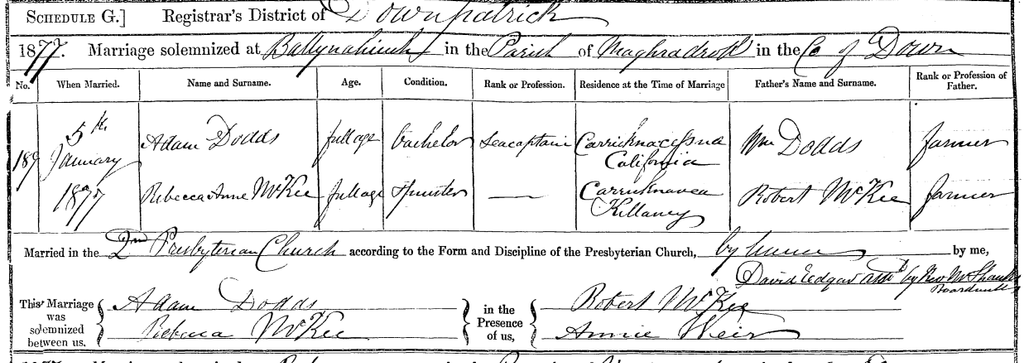
The Valuation Book for 1866-1881 shows Robert still there but the name James McKee is added in blue. During this period the Northern Whig reported a wedding at Ballynahinch by the Rev David Edgar of Captain A Dodds of San Francisco to Rebecca Ann Todd, youngest daughter of Robert McKee. I presume that she was “Rebecca Ann Todd McKee” but Todd is not listed on the certicate- possibly through lack of space. Another newspaper said the wedding was at Ballymacarett.
Adam’s father was a Carricknacessna farmer and he gave that and San Francisco as his address. Adam was a sea captain. I have been unable to learn any more about them.
The Valuation Book for 1881-1897 continues to show Robert and James sharing. However, the Ulster Echo for 17th April 1896 shows the notice of the death of Robert McKee at his Poagsburn residence in his 86th year. Wife Elizabeth inserted this. He was buried at 1st Boardmills Presbyterian Church graveyard on the following Monday.
The next Valuation Book covered 1897-1906. Robert’s name was scored out in 1897 James held the farm alone. James was reported in the Northern Whig of 23rd January 1904: “a noticeable and perhaps unique figure of the day was that of Mr James McKee of Poagsburn who recaptured the cup in the swing (?) class.
The last Valuation Book (sadly for genealogists) was for the years 1909-1923. James McKee’s name continued but a Robert McKee was added in red. The entry is stamped “In Fee” reflecting the government assisted by-out of farms by tenants from landlords in the first decade of the century.
The tax records may not be available but three more newspaper records assist us after this period:
James McKee’s death was reported in the Northern Whig on 9th January 1935. This was inserted by his wife Jane. He was in his 88th year and he was buried at 1st Boardmills Presbyterian Church graveyard.
Next came an advert by Mrs McKee in March 1939 letting 28 acres grazing land.
Finally, presumably ending the McKee association with Poagsburn, was an advert about Poagsburn being put up for auction in 1945, below. Note that John McKee has given the instruction which could make him the current owner or the executor.
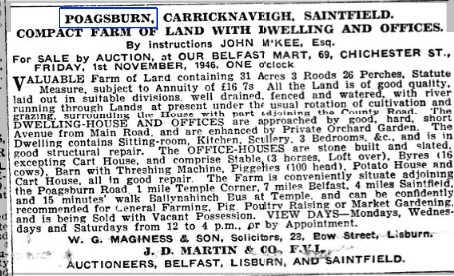
Subsequent newspaper mentions show that James Gill bought the farm.
Looking through and combining newspaper, land, gravestone and registers of births, marriages and deaths we can see the following:
Poagsburn had been farmed by the McKee family for generations up until the sale to James Gill in 1945. James Gill died in 1963, incidentally.
Jane McKee, sister of my wife’s ancestor Joseph McKee, married into this family, though she was a cousin already of it.
Her parents in law were Robert and Eliza. Robert held the land until his death in 1876 at the supposed age of 85. Eliza lived on with her son at the farm until her own death in 1907 at the apparent age of 86.
Robert and Eliza had five children. These were James, who inherited the farm and who married Jane, John (who went to America), Lizzie, Isabella and Rebecca Ann Todd McKee, referred to above.
Church records list them thus:
- Eliza, born 15th May 1846, baptised 15th December 1846
- James, born 2nd February 1848, baptised 25th February 1848 [was he sickly?]
- John
- Isabella, born 9th June 1853, baptised 3rd July 1853
- Rebekah Anne, born 1st July 1856, baptised 3rd August 1856
The Boardmills Churches saw divisions in the 19th century and this led to people changing and sometimes returning to a church. Eliza Little appeared before the session and was publicly censured for having been married by Joseph Weir. The date is not recorded but it was either in or after 1842, and presumably was required in order for this church to baptisse her children.
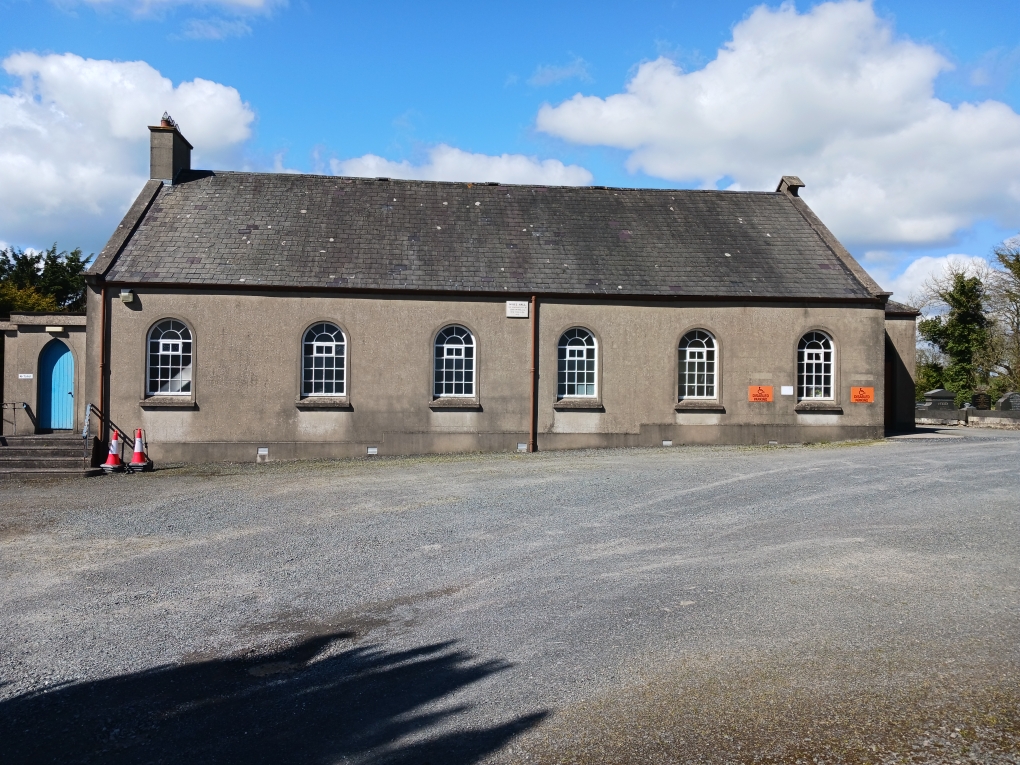
I have established nothing about descendants except of James and Jane. John was a successful businessman who remained unmarried, was a Christian and benefactor of his home church of Boardmills Presbyterian. In 1926 he paid for the building of a church hall which bears his name (although this is a replacement building, the original having burnt down).
Below: Boardmills First Presbyterian Church McKee Hall (author’s own):
Lizzie was the elder daughter and she married James Martin of Creevy on 17th October 1890.
James McKee and Jane McKee had six children:
- Margaret, known as Maggie, born 27th Jan 1891
- Robert, who farmed with his father, born on 21st December 1894
- Isabella, born 7th May 1896. She married William Edgar Scott on 30th August 1918.
- Jane, born 13th February 1900
- John, born 21st June 1904. I think he was the father of the Molly McKee who had a horse.
- Martha Elizabeth, born 1st June 1906
The family lived, with James’s widowed mother Eliza, at Poagsburn until her death in 1907.

The 1911 census shows that Poagsburn was now House 29 on the enumerator’s route (it had been 20 in 1901).
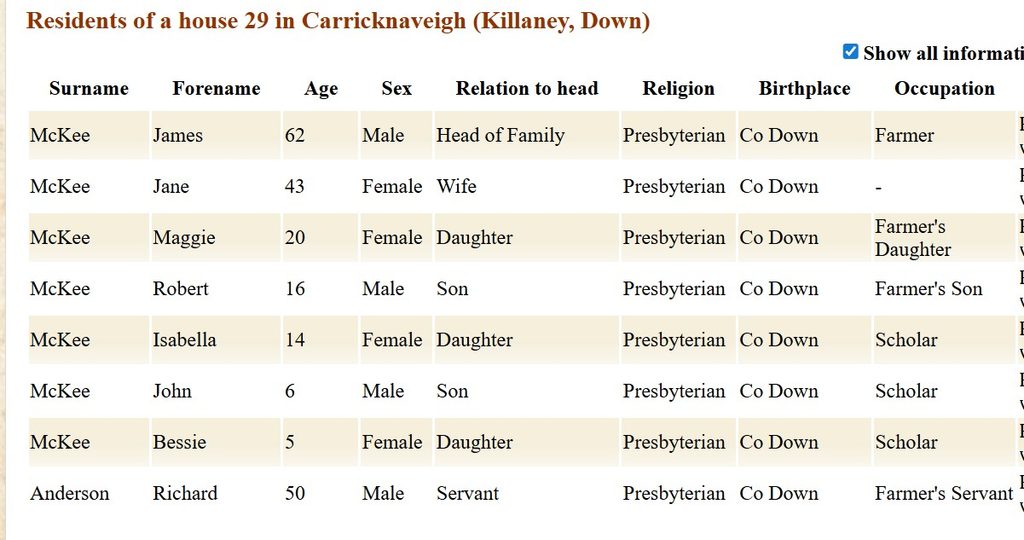
James McKee died in 1935 at an estimated age of 88. Certificate is copyright GRONI.

As stated above, after Jane died the farm was sold. Jane’s father in law Robert had left a will, available via PRONI.
My own notes say that he died on 10th April 1896 and probate was granted on 22nd November 1897. The will was written 6 days before his death. He left his farm to his son James. The will referred to his wife Bessie. The Reverend John Lindsay McCandless of Bresagh and his son James McKee were the executors.
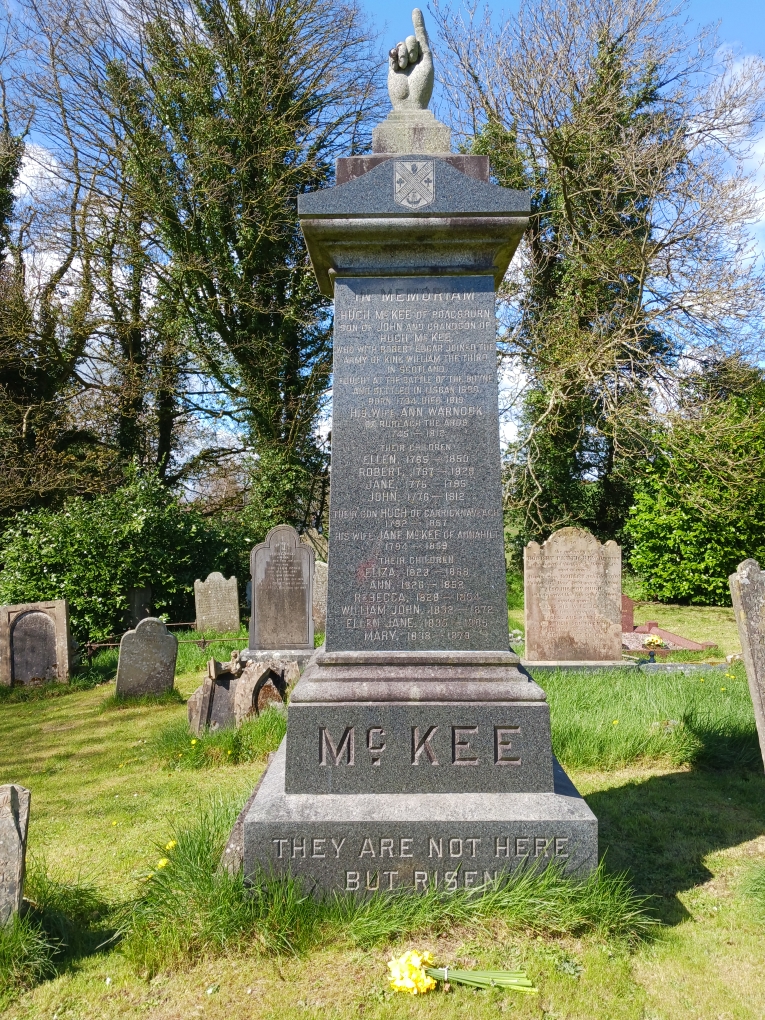
One side of the McKee Memorial at Boardmills supports the information above and adds to it, as it says:
“Robert McKee of Poagsburn Son of James of the Ouchley (sic) and Grandson of Hugh 1881-1896
His Wife Elizabeth Little 1821-1906
Their Daughter Isabella McKibbin 1853-1871
Their Son John McKee 1851-1931
who erected this monument, was the faithful and generous friend of First Boardmills Congregation and donor of the Adjoining McKee Hall Interred in Woodlawn Cemetery New York”
Thus we can add the name Isabella to those children above: presumably John McKee knew the names of his own siblings!
The death registration of Isabella shows that she was a teacher if only 18 years old and died of a fever. No mention is made of the name McKibbin here. Copyright irishgenealogy.ie

The memorial adds a surname to James McKee’s mother and describes his grandfather as being “of the Ouchley.” Presumably this means Oughly Townland, adjacent. Is it possible that James was farming there and after the murders in 1798 took over the now vacant farmland?
The parish records confirm the dates of birth of the children of Jane and James McKee and supplements them with baptismal dates.
Another problem of accuracy: the Reverend David Stewart, of whom I have written above in places, has added some notes to the church records regarding the memorial:
He corrects the typed “Robert M’kee of Poagsburn was a son of James M’Kee, oughley, and grandson of Hugh, changing son to brother. His dates 1811-1896 and (“I knew him. D Stewart.”) his wife was Eliza Little 1821-1905. Their Dau Isabella (married M’kibbin) 1853-1871. John M’Kee, New York, who erected the peculiar tombstone in Boardmills, was also a son. He died in 1932.
Then handwritten “James M’Kee, Poagsburn, also a son, died Mar 1935 aged 88 years. Buried on 2 April.”
This concerns me because as shown above, daughter Isabella was an 18 year old minor and stated to be a spinster on her death certificate. I cannot find a marriage record for her, either. Was Rev David Stewart in error here? If, was he wrong in saying that Robert McKee was a brother of James of Oughley?
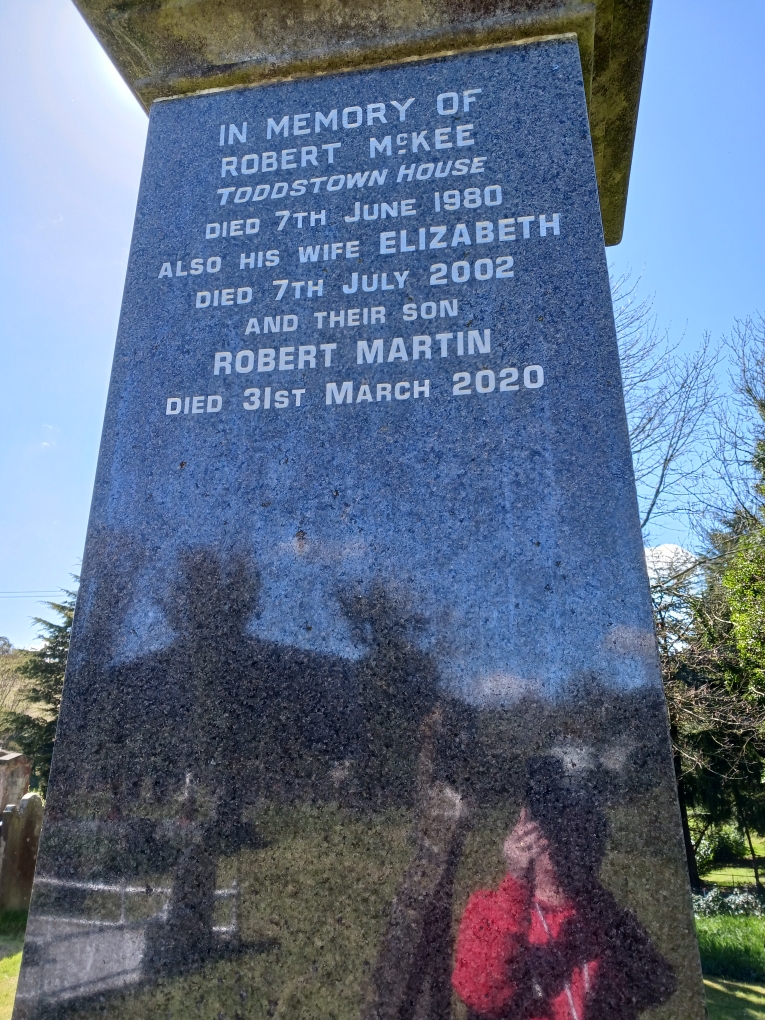
Some of the infomation inscribed on the memorial above does not tally with known records from the church or is contradicted by the later memorial. The later memorial has the advantage of having precise dates of death. It says Hugh McKee died on 12th December 1812 whereas the big memorial inscription says 1819.
The later memorial indicates an Ellen Jane McKee was born around 1824 but this is not supported by baptismal information from the church. Now, she could have been baptised elsewhere as she was a grand daughter, and not every child was baptised.
I think that the McKees of Poagsburn gave up their ancestral home and bought Toddstown, which is very close by, but I do not know exactly when they moved there.
Certainly Elizabeth McKee’s letter demonstrates that her husband Robert was the nephew of James McKee who died in 1937 and the will of this James McKee serves to confirm the connections.
I have not located the marriage of Robert McKee and Elizabeth, and do not know her maiden name, but they had a son named Robert Martin McKee who married a woman named Doris. Robert McKee died in June 1980 and Elizabeth in July 2002. Their son was known as Martin and his name is to be found often in newspapers with regard to livestock, being famous for his blond heifers. Martin died in March 2020.
The Grahams
As shown further above, Hugh McKee married Margaret Graham and her father was stated to be a farmer named James Graham. The registration is hard to read but she was living at Cargygary at the time, in Annahilt parish.
Cargygary is a townland of 469 acres.
We are very lucky to have a will which is detailed and accessible. It clearly was written by Margaret’s father and lists his various children and two farms. I reproduce it here:

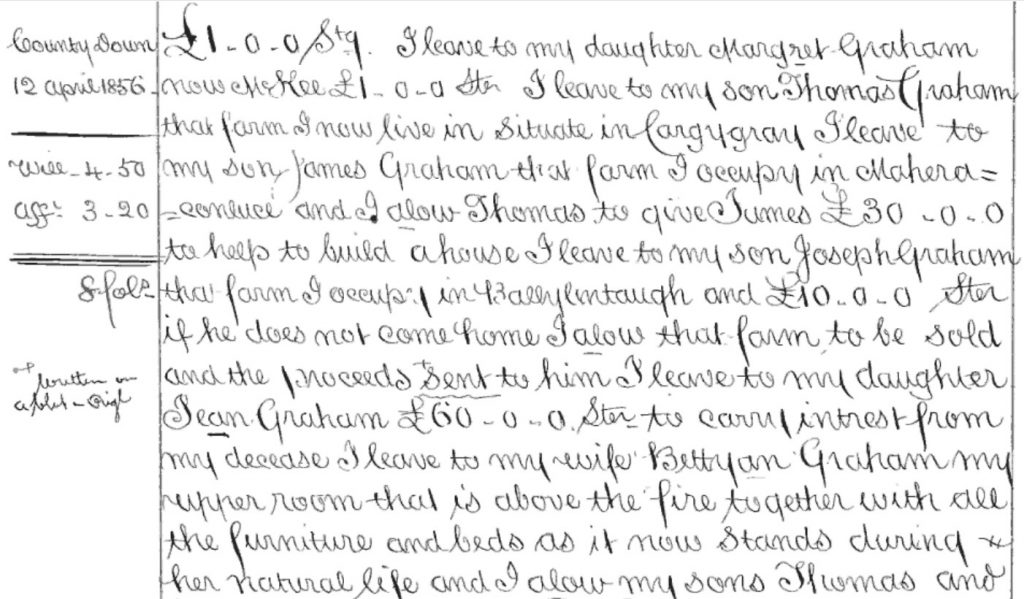

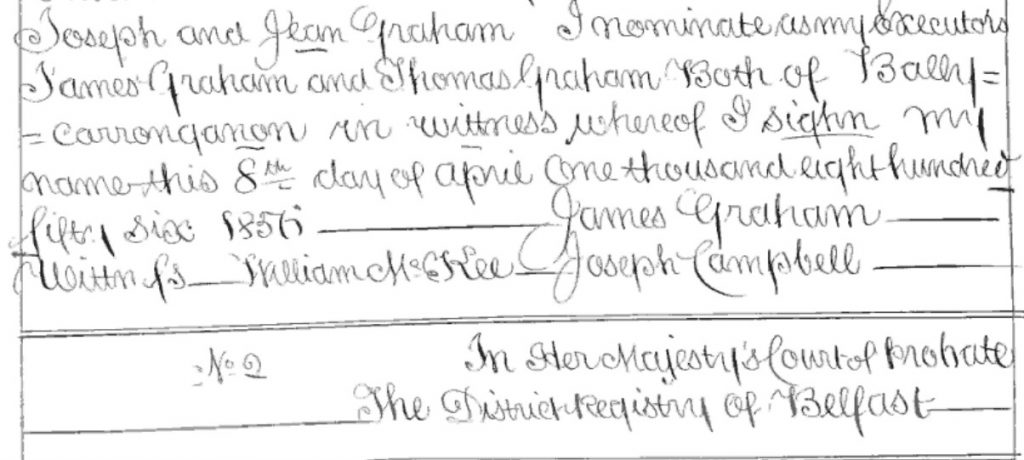
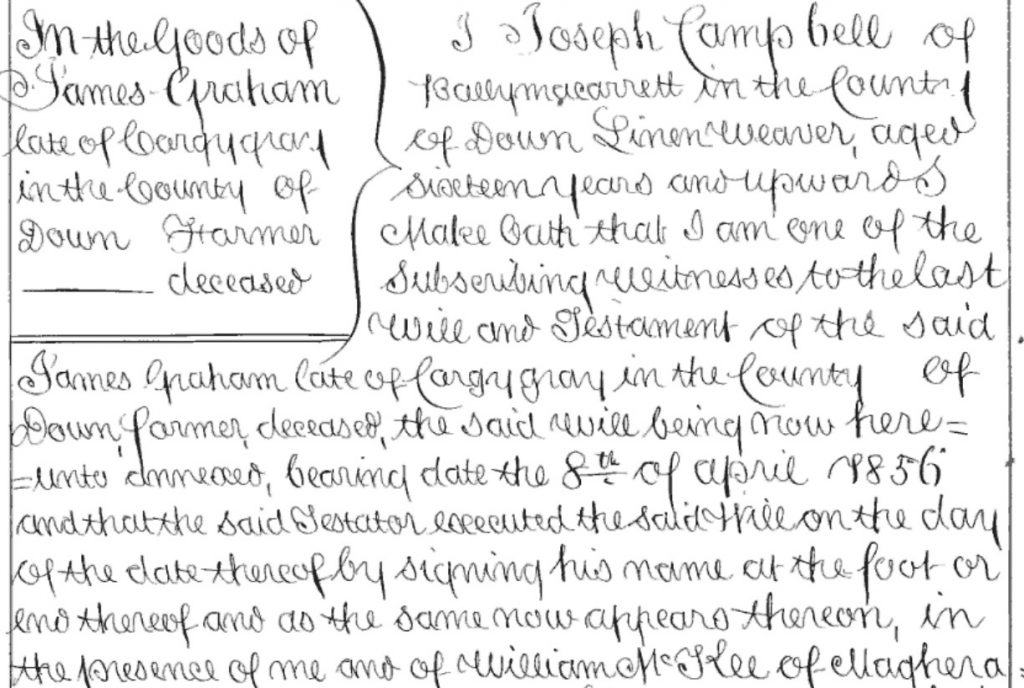
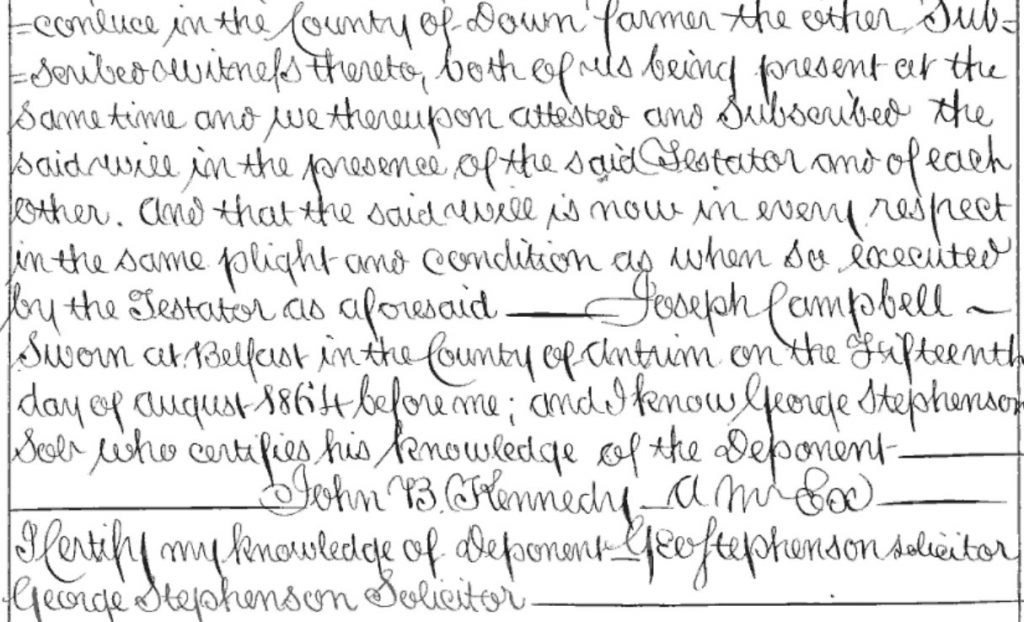
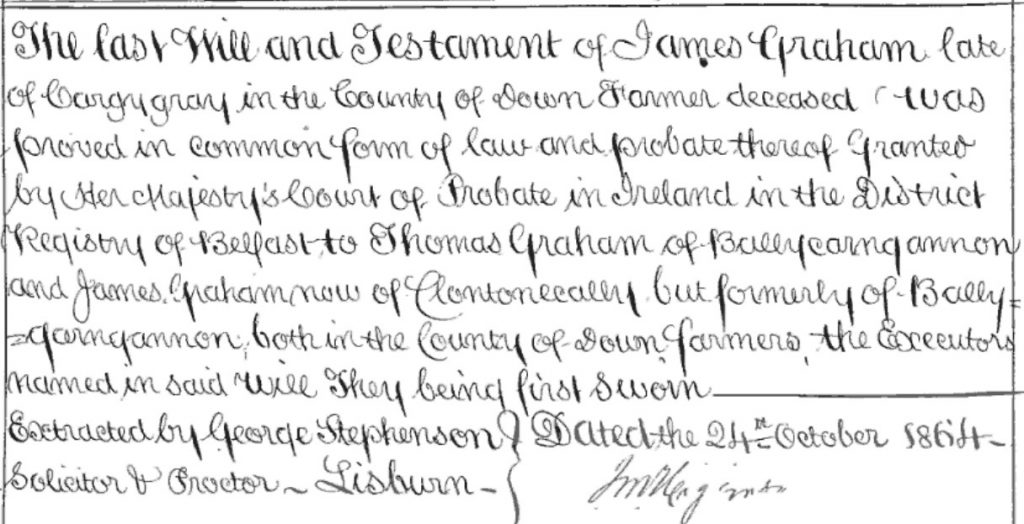
At present I cannot list the children in order of birth. All were born before statutory registration began in 1864 and I have not had time to consult parish records at PRONI yet.
Still, we can establish the following:
James Graham married Betty Ann and they had this family:
- Joseph, a farmer received the farm at Ballylintaugh
- Robert living in America in 1856
- Jean living at home
- Mary Ann, married to someone named Gillmore (I note that James spelt Ann as “an” several times in the will).
- Elizabeth, married to someone named McReely or McReevy
- Margaret, married to Hugh McKee
- Thomas, a farmer, received the farm at Cargygary (mispelt as Cargygray in the will)
- James, farmer received the farm at Magheraconluce.
Joseph, James and Thomas are likely to have been the oldest as they received land. Robert may have been one of the younger children as he moved to America and Jean the youngest or second youngest as she was unmarried.
Father James lived in a farmhouse at Cargygary at the time of his death in 1856. The pictures show that Carygray and Magheraconluce are adjacent.
Griffith’s Valuation of 1864 does not list any Graham at Carygary but does show Eliza Ann Graham (James’s widow) as holding plots 18 and 19 in Magheraconluce.
William McKee held plots 16 and 17. This may well be the witness to the will and could be a relation of Hugh McKee.
However, the first revised book does show Eliza Anne Graham as holding Cargygray 1, house office and land from the Marquis of Downshire. She held 23 acres, 1 rod and 30 perches. The land and buildings together were valued at £23-10-0, with the buildings valued at £4-10.
Eliza Ann Graham, widow of a farmer, died on 7th June 1879 at Cargygary. She was said to be 81 years old. Thomas Graham of Cargygary registered her death with a mark.

According to the will, this land at Cargygray was to go to Thomas Graham, but it seems to have been held by his mother as shown above. Actually, the first land revision book shows that Thomas held the farm at Ballylintagh, plot 25 9renumbered as 25Aa. A house was added to the plot, presumably for Thomas to live in. There were 25 acres 15 perches initially but later this was reduced to 16 acres 2 rods 33 perches, now valued at £14-15 shillings.
I suspect that Thomas had taken or bought this land because his brother Joseph did not intend to farm it. Their father’s will allowed for the possibility that he might prefer the money.
The second revision book (B) shows a change of land holding from Thomas Graham to Thomas Black. This is because Thomas Graham died of gastro-enteritis on 30th June 1883 at Cargygary. His wife Eliza registered the death.

Poor Thomas had only been married to Eliza Black for less than four years. They do not seem to have had any children.
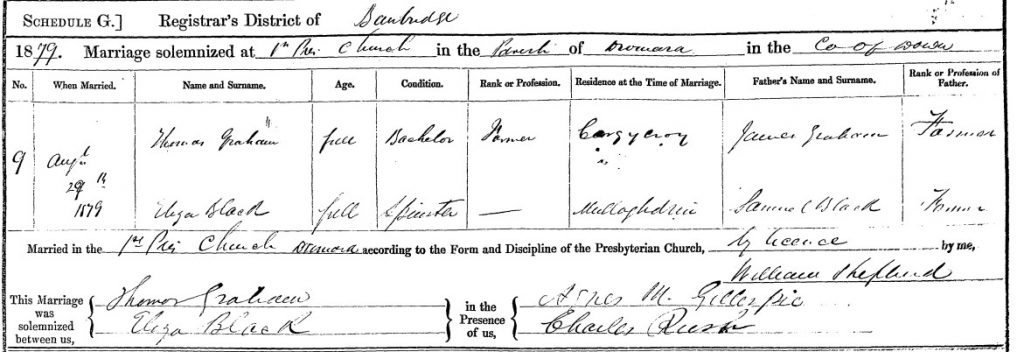
The third son to inherit a farm was James who received the farm at Magheraconluce. The first land revision book showed that this was plot 18 and 19. The land at 18 was small, a little over 3 acres, valued at £2-15-0. However, plot 19 was a larger affair, 17 acres valued at £13-15sh. A house was added worth £1.